Get Full Government Meeting Transcripts, Videos, & Alerts Forever!
Get email alerts on the Mechanical Refrigerants topic
No spam. Unsubscribe anytime.
Council reviews proposals to allow low‑GWP refrigerants amid safety and standards concerns
Summary
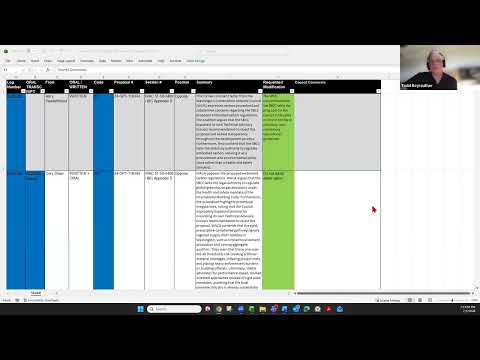
SBCC staff reported 30–38 comments on two mechanical code proposals to permit A3/A2L refrigerants (including propane/R‑290); members discussed safety, industry readiness, PFAS concerns, and whether referencing IEC/European certification standards is lawful versus localized UL/ASHRAE standards.
At the July 7 work session, the State Building Code Council reviewed two mechanical‑code petitions (GP1112 and GP1113) that would broaden equipment options to include lower‑global‑warming‑potential refrigerants and, in some instances, reference international certification standards.
Dustin, SBCC staff, summarized that the mechanical proposals generated roughly 30–38 comments: about 14 in opposition, 15 in support and several conditional or modification requests. Opposition themes included industry readiness to handle more flammable refrigerants in residential settings, concern that relying on IEC or European certification standards could bypass U.S. localized safety standards (UL and ASHRAE), and a claim that certain refrigerant chemistries could lead to PFAS contamination. Supporters argued the changes would allow access to very low‑GWP alternatives (for example R‑290/propane or CO2 systems), aligning Washington with international practice and state‑level decarbonization goals.
Ben (stakeholder liaison) and council members noted the proposals are intended to expand equipment options, not to impose new mandatory requirements. "The intent for them is to provide additional equipment options," Ben said, adding proponents argue these pathways help transition to very low‑GWP refrigerants.
Members asked detailed technical and legal questions. Roger and other council members asked whether the council may lawfully adopt references to IEC or other international standards or whether SBCC should rely on the U.S.‑localized UL standard that has been adapted to U.S. practice. Derek (legal counsel) noted the council would review those questions and consult with staff and AG office on lawfulness and potential implications.
Members also requested more technical context on relative GWP benefits and safety trade‑offs (for example, training, inspection and code compliance impacts if flammable refrigerants are allowed in more settings). Vikram, who has professional experience running whole‑building LCA work, urged the council to consider practical industry readiness and comparability across standards.
Next steps: Staff will post the proposal redlines in CR102/CR103 documents and the council asked staff and stakeholders to prepare amendment packages and technical clarifications for upcoming meetings. No final action was taken at the work session.