Get Full Government Meeting Transcripts, Videos, & Alerts Forever!
Get email alerts on the Zoning Data Centers topic
No spam. Unsubscribe anytime.
Township board forwards draft data‑center rules to planning commissions, with stricter buffers, studies and size limits suggested
Summary
Smithfield Township supervisors voted to send a draft ordinance restricting data centers to a new heavy‑industrial district to planning commissions and to authorize advertising for adoption, while public commenters and several supervisors pressed for larger buffers, independent studies and building size caps.
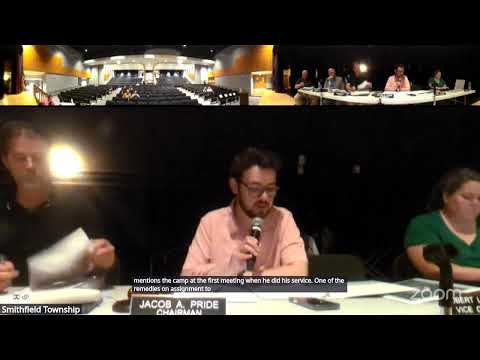
Smithfield Township supervisors voted at a special meeting July 11 to send a draft zoning amendment that would remove data centers from the M‑1 and ED districts and concentrate them in a new heavy‑industrial (H‑1) zone to the township’s southern industrial area, and to authorize advertisement for adoption subject to solicitor and engineer review and further edits. The motion was made by a committee member and seconded by the chair; the transcript records the board’s approval but does not provide a recorded vote tally.
The draft, presented by the board chair and township manager Julia, proposes multiple new limits on data‑center development, including a 500‑foot buffer from residential and other sensitive receptors, new setback standards, baseline environmental testing, vibration and noise controls, requirements for an energy‑use plan and decommissioning/reclamation conditions. As presented, the ordinance also requires documentation of transmission‑service approvals and, for larger facilities, a minimum share of renewable generation in the operator’s supply plan.
Why it matters: Data centers are capital‑intensive, long‑lived facilities that can involve large electrical and water demands, substantial fuel and battery storage, and continuous noise and traffic. The board placed the draft under an expedited schedule so planning officials can review the changes during the mandatory 30‑day review window required for advertisement and adoption; staff said the board aims for final adoption in August if legal and planning reviews allow.
Public concerns and technical clarifications
During a lengthy public‑comment period, residents urged stricter limits than those initially proposed. One resident told the board, “500 feet is not enough,” and several speakers asked for larger landscape buffers, denser screening plantings and independent studies of property‑value, noise and vibration impacts. Commenters also raised floodplain and emergency‑response concerns tied to on‑site fuel and battery storage, asking whether developers would be required to hold funds or guarantees to remediate contamination after extreme events.
Township staff and board members acknowledged several draft provisions read unclearly. Attorneys and staff discussed whether the draft’s floodplain language — which referenced both “100‑year” and “500‑year” elevations — should be simplified to a more straightforward prohibition in the 100‑year floodplain, subject to solicitor review. The township manager said staff would present an updated redline to planning staff for informal recommendations ahead of the planning commission meeting on Thursday, with formal comments from that commission possible later in July.
Board changes sought before advertising
Several supervisors said they wanted to incorporate additional protections before advertising the ordinance. Proposed adjustments the maker of the board motion listed included: increasing front/side/rear building setbacks (one proposal set front setbacks at 250 feet and side at 150 feet), raising the landscape buffer from 100 to 250 feet and requiring denser plantings, requiring independent appraisals of property‑value impacts, requiring independent noise and vibration studies, and setting a cap on the maximum square footage of any single building in the H‑1 zone (a frequently mentioned figure was 15,000 square feet, though members discussed a range of alternatives).
On energy, the draft calls for an energy‑use plan and documentation of utility consent and transmission agreements; the transcript records discussion of thresholds (staff cited a 50‑megawatt benchmark used as a reference in other counties) and an existing 10% minimum direct renewable generation requirement in the draft for larger facilities, which some supervisors suggested increasing.
Motion and next steps
A committee member moved to send the redlined draft to both the Smithfield Township planning commission and the Monroe County Planning Commission and to authorize advertisement for adoption, conditioned on solicitor, engineer and zoning‑officer review and the changes discussed at the meeting. The motion directed staff to incorporate a set of enumerated edits before Thursday’s planning commission review. The motion was seconded and the board approved it; the transcript does not record a roll‑call tally. Staff said an updated ordinance would be circulated to planning staff as soon as possible and that the planning commissions’ formal recommendations could require re‑advertising and another 30‑day review window if they result in substantial changes.
The board also reiterated that certain approvals related to large consumptive water uses would remain external to township zoning — for example, projects exceeding watershed commission thresholds would need permitting from the Delaware River Basin Commission.
What’s next: The township manager said staff would circulate an updated draft to planning staff on Thursday for informal comments and that the planning commissions would have an opportunity to deliver formal recommendations later in July; the board said it hopes to conclude the amendment process in August, subject to required review periods and any re‑advertising triggered by later edits.