Get Full Government Meeting Transcripts, Videos, & Alerts Forever!
Get email alerts on the Paroleboard Oversight topic
No spam. Unsubscribe anytime.
House Judiciary Commission grills Parole Board and DCR over release procedures after recent femicide
Summary
Lawmakers questioned the Junta de Libertad Bajo Palabra and the Department of Correction and Rehabilitation about eligibility rules, supervision practices and staffing after the killing of Jennifer Marie Torres; the Board and DCR agreed to provide detailed statistics and program records within five days.
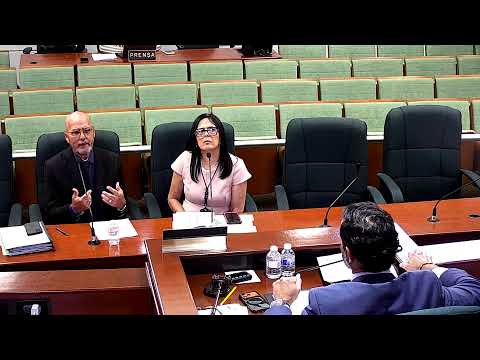
The House of Representatives Judiciary Commission held a public hearing July 9, 2026, to examine the operations of the Junta de Libertad Bajo Palabra (Parole Board) and the Department of Correction and Rehabilitation (DCR) after a recent femicide that raised questions about how certain detainees were evaluated for supervised release.
The panel’s chairman opened the session by citing House Resolution 139 and saying the committee’s intent was “not to react for headlines but to analyze, educate and improve the functioning” of the Board. The hearing brought the Parole Board’s president, Lic. Samuel Silva Rosas, and multiple Board members to explain referral, evaluation and supervision procedures.
Silva Rosas read the Board’s written ponencia and described the agency as a quasi‑judicial body attached to DCR. He said referrals are generated by DCR when a confined person reaches the legal minimum of their sentence and that an official examiner prepares an evidentiary file and recommendation for the Board. “La junta y el DCR trabajan coordinadamente,” Silva Rosas said, summarizing the interagency role in supervision.
Board members and the director of examiners described the eligibility review as a multi‑factor analysis under the Board’s regulation (referenced in testimony as Reglamento 96‑84, 2025) and the governing statute (Ley 118 de 1974). They listed typical criteria: degree of rehabilitation and institutional adjustment, criminal history, sentence computation and liquidation, custody level, victim opinion, health and psychological reports, structured release plans including residence and employment, and program participation.
Rep. José Rosendo and other legislators pressed the Board for concrete numbers. The director of examiners provided a five‑year referral trend: 2022 — 742 referrals; 2023 — 1,535; 2024 — 1,179; 2025 — 995; and 2026 (to date) — 518. The Board said it supervises about 577 released individuals as of July 7, 2026, and admitted it lacks a dedicated statistics/analytics unit to produce some requested breakdowns.
Lawmakers repeatedly returned to the case of Carlos Stefano Pino (the detained subject at issue). Committee members said media reports suggested missing documentation in the Board file; Silva Rosas and Board staff said the certification of sentence had been supplied and that the criminal “liquidación” (sentence computation) exists in the criminal file. “Las certificaciones sí están en el expediente,” Silva Rosas said. The Board agreed to deliver clear documentation to the committee within five days.
Members also pressed the Board on victim notice and jurisdictional rules. Witnesses said notice to victims is mandatory (as amended under Ley 90 and related provisions) and that ineffective notification can deprive the Board of jurisdiction over a petition. Board representatives stressed that while victims’ opinions must be considered, they do not carry a veto.
Questions about monitoring and follow‑up produced two recurring themes: variability in practice and resource constraints. Board and DCR witnesses described the standard instrument for release (the “previo mandato”), reporting to a technical socio‑penal supervisor (TSS) within 48 hours, community programs and electronic monitoring as conditions when needed. The Board acknowledged that the formal regulation currently requires follow‑up views at least every two years but that some cases and internal practice involve six‑month reviews; several Board members recommended returning to annual follow‑up visits.
DCR representatives told lawmakers the department supervises thousands of participants across community programs and institutional populations. Madeline González Ortiz (secretaria auxiliar, Programas y Servicios, DCR) and Lic. Francisco Méndez Rivera (abogado principal, DCR) said DCR will provide requested staffing numbers, psychologist counts and program participation lists. DCR reported roughly 6,716 participants in community programs and said it is recruiting additional technical personnel; its witnesses estimated a shortfall of about 94 socio‑penal technicians and about 15 additional psychologists to meet current demand.
Several members highlighted legal changes and retroactivity concerns. Witnesses referenced the statute that created the Board (Ley 118 de 1974), court decisions (Paul v. Calderón Negrón was cited in testimony) and subsequent amendments discussed in the hearing that changed minimums and exclusions for particular offense types. The Board said eligibility often depends on the law in force when the offense occurred and that some exclusions for sexual offenses and others resulted from later amendments.
On gender‑based violence, members called for specialized protocols. Rep. Gutiérrez Colón, noting the victim in the publicized case, said mechanisms for evaluating offenders convicted of gender violence may be insufficiently specialized. Board and DCR witnesses confirmed that some standard programs (for example, the “Aprendiendo a Vivir Sin Violencia” module) exist and can address relevant factors but agreed that specialist protocols, gender‑violence expertise and better access to tailored interventions would strengthen assessments.
The committee directed multiple information requests: the Board and DCR were given five business days to produce (1) statistics on similar cases and recent referrals, (2) certification and liquidation documentation for the Pino file, (3) records of any private donations received by the Board in the past five years and how funds were used, and (4) staff counts and program participation data (DCR). The hearing concluded with the chairman saying the commission will hold additional sessions and may seek further legislative or regulatory recommendations.
Why it matters: Lawmakers framed the hearing as fact‑finding after a high‑profile violent crime involving a person previously under supervised release; witnesses provided a detailed, largely procedural picture of how referrals, evaluations and supervision are supposed to work, while also acknowledging gaps in data, staffing and specialized protocols that lawmakers said must be addressed.
What’s next: The Board and DCR promised to deliver the requested records within five days; the commission signaled further public hearings and potential regulatory or statutory work based on those materials.
Sources: Hearing testimony before the House of Representatives Judiciary Commission (Puerto Rico), July 9, 2026. Testimony included Lic. Samuel Silva Rosas (president, Junta de Libertad Bajo Palabra), Doctora Carla de Jesús Fuentes (member), José Rosendo (member), Carlos Tabares (member), Lic. García (director of official examiners), Madeline González Ortiz and Lic. Francisco Méndez Rivera (DCR).