Get Full Government Meeting Transcripts, Videos, & Alerts Forever!
Get email alerts on the Policy Crosswalks topic
No spam. Unsubscribe anytime.
Coalition and POCTA summarize crosswalk and gap‑fill recommendations across multiple PLA codes
Summary
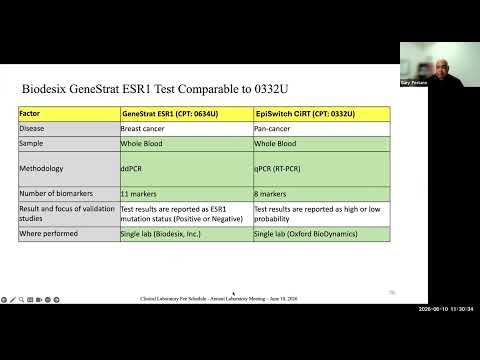
The Coalition for 21st Century Medicine and the Point of Care Testing Association presented a package of crosswalk and gap‑fill recommendations for numerous PLA codes — from MRD and oncology panels to resistance gene assays — citing shared methodology, specimen types and resource profiles as comparators for CMS rate setting.
Mike Ryan, representing the Point of Care Testing Association and the Coalition for 21st Century Medicine, summarized recommendations covering roughly ten PLA codes, arguing that methodology, specimen type and analyte parity should guide CMS crosswalk decisions and that selected resource‑intensive tests should proceed to gap‑fill for local MAC review.
He presented examples: a recommendation to gap‑fill an amplified probe test for carbapenem resistance genes (arguing that the code descriptor requires multiple gene targets and that common practice tests five or more genes), proposals to crosswalk GFAP (glial fibrillary acidic protein) to a neurofilament light chain code due to shared immunoassay methodology, and a set of oncology NGS crosswalks (including fetal NIPT crosswalks, MRD tests and CGP tissue tests) justified by similar analytes and workflows. For some novel MRD or tumor sequencing tests, the Coalition recommended gap‑fill, citing computational/bioinformatics and laboratory resource differences from legacy CLFS codes.
Nut graf: The Coalition urged CMS to use a combination of crosswalks where technical comparators exist and gap‑fill where the test architecture (depth of sequencing, bioinformatics, patient‑specific probe manufacturing) materially changes resource requirements; presenters repeatedly framed recommendations around methodology, specimen type and algorithmic outputs rather than clinical indication alone.
The transcript records the Coalition moving quickly through many codes, allotting time for questions and deferring detailed data to submitted slide decks or follow‑up documents.