Get Full Government Meeting Transcripts, Videos, & Alerts Forever!
Get email alerts on the Esr1 Ddpcr topic
No spam. Unsubscribe anytime.
Manufacturer presents ddPCR ESR1 cfDNA test and crosswalk rationale to CMS panel
Summary
Biodesics presented PLA O634U, a ddPCR plasma test that detects 11 ESR1 variants for monitoring endocrine‑therapy resistance in HR+ advanced breast cancer and recommended crosswalking to O332U based on method, specimen type and marker counts; CMS panelists asked for detailed LOD and concordance data.
Gary Pastano, the chief scientific officer and New York State laboratory director for the presenting laboratory, described PLA code O634U as a droplet digital PCR (ddPCR) oncology assay that analyzes cell‑free DNA from plasma to detect 11 ESR1 estrogen‑receptor variants and report mutation status as positive, negative or QNS.
Pastano said specimens are collected in cfDNA tubes and shipped to a centralized laboratory where nucleic acid extraction, ddPCR droplet generation, thermal cycling and droplet reading are performed. He listed required equipment (AutoDG droplet generator, deep‑well PCR thermal cycler and droplet reader) and said qualified laboratory professionals must review and sign out results.
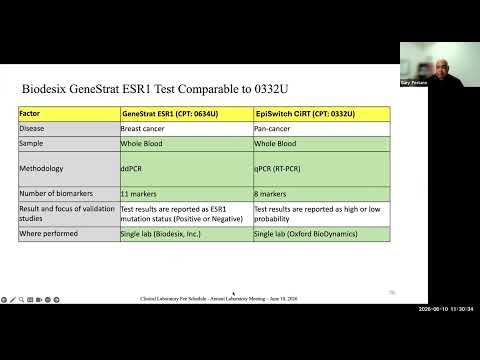
The presenter recommended crosswalking O634U to O332U — an oncology pan‑tumor genetic profiling assay — arguing parity in specimen type (blood/plasma), PCR‑based methodology, the same analyte class (DNA) and similar numbers of markers (11 versus eight). Pastano said prior validation showed concordance with the Guardant360 assay and reported one variant detected with superior sensitivity versus the FDA‑cleared comparator; he offered to provide the exact comparative data to the panel.
At question, a CMS panelist, Dr. Bridges, asked for analytic details: validated limit of detection (LOD) per variant, limit of blank, and whether any crosstalk exists across the 11‑plex. Pastano replied that the minimum level of detection is three to four copies depending on the variant, reported no observed crosstalk at tested inputs and said full, variant‑by‑variant LOD and concordance tables would be supplied in follow‑up. The panelist also asked whether the assay output is intended to show progression during endocrine therapy; Pastano said the report is qualitative (positive/negative) and that the 11 variants represent about 98% of prevalent ESR1 mutations.
Nut graf: The presentation focused on clinical utility for patients with hormone‑receptor positive advanced breast cancer who are at risk of aromatase‑inhibitor resistance; the laboratory asked CMS to adopt an existing crosswalk (O332U) for rate setting while providing additional analytic data on request.
The meeting record shows CMS panelists pressing for numeric evidence (LOD per variant, head‑to‑head concordance) before endorsing the crosswalk, and the presenter agreed to deliver the detailed data to the agency.