Get Full Government Meeting Transcripts, Videos, & Alerts Forever!
Get email alerts on the Attendance And Adm topic
No spam. Unsubscribe anytime.
District officials say Instructional Time Model helped capture nearly all available ADM; online program improvements highlighted
Summary
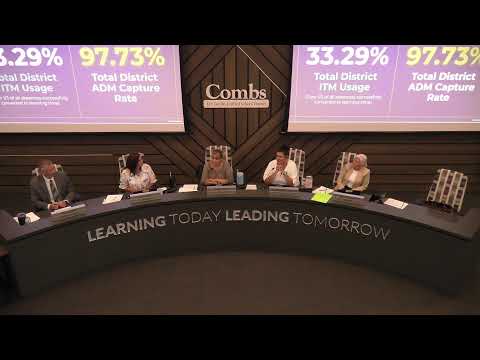
Dr. Fountain presented the district’s Instructional Time Model (ITM), a post‑COVID coding framework that allowed the district to record diverse learning pathways. She said ITM usage reached roughly 33.3% districtwide while overall ADM capture approached 97%, helping preserve state funding tied to attendance.
Dr. Fountain (speaker 7) told the governing board the Instructional Time Model — adopted after House Bill 2862 (2021) — provides flexible, anytime/anywhere attendance coding that helps the district capture state funding when students complete meaningful learning outside the traditional seat-time model.
She explained the process: a student absent is marked as absent or unexcused, then teachers provide targeted work for completion; when the work is turned in, the district codes the absence as reconciled using ITM (an "x" code) so the state treats the student as present for funding purposes. "It allows us to meet varied learning styles and learning beyond the traditional school day," Dr. Fountain said.
Dr. Fountain said the district’s online program increased the ADM capture rate from roughly 27% early in the year to about 100% for some programs after system improvements, and districtwide ITM usage averaged about 33.29%. Overall the district captured about 97% of available ADM. She cautioned there remain challenges at the high‑school level (about 93% capture) related to revenue sharing with external online providers and ensuring students take four classes to generate full ADM.
Board members praised the presentation and asked for continued emphasis on quality of makeup work rather than simply counting minutes. The superintendent and Dr. Fountain said the district will continue to refine parent attestation and project‑based coding and provide updates in October when additional accountability and letter‑grade data are available.
Why it matters: ADM drives state funding for schools; more-complete ADM capture helps stabilize district revenues while the district balances instructional quality and attendance reporting.
What’s next: Staff will continue to refine ITM procedures, focus on high‑school capture concerns and report additional outcomes in the fall.