Get Full Government Meeting Transcripts, Videos, & Alerts Forever!
Get email alerts on the Automated Crosswalk Enforcement topic
No spam. Unsubscribe anytime.
Montgomery delegation debates widening automated crosswalk cameras, weighing pilot, vendor safeguards and revenue rules
Summary
The Montgomery County delegation discussed MC 10‑26 to authorize automated crosswalk enforcement countywide. Lawmakers debated removing a school‑zone restriction, pilot size and duration, vendor payment and procurement rules, privacy/signage and whether ticket revenue must fund safety fixes. No votes were taken; work continues next week.
The Montgomery County delegation on the call examined MC 10‑26, a bill from Delegate Foley that would authorize automated crosswalk enforcement countywide and remove a current school‑zone limitation, but took no votes and asked for more amendment language before deciding next steps.
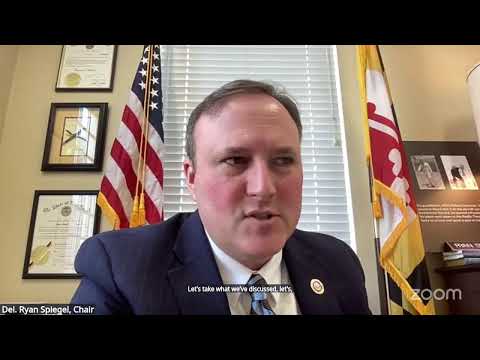
The chair, Delegate Spiegel, opened the discussion by noting Delegate Foley was absent and that vendor and county staff were on the call for technical questions. Committee member Delegate Moon said he broadly supported authorizing camera enforcement but urged caution: if the bill removes the school‑zone restriction, the delegation needs either a statutory limiting principle or a staged pilot to prevent unconstrained deployment.
"If we go to remove the school‑zone restriction . . . are we then just leaving it totally loosey‑goosey as to where these are going to be located?" Delegate Moon said, urging a limited pilot and clear rules the public can understand.
County staff, led by Director Chris Tipperary of the automated enforcement division, said the county plans to site cameras based on crash and high‑incident data and to post notices at camera locations. Tipperary said the county uses a fixed‑fee procurement model rather than a percentage‑of‑fines arrangement, to avoid creating per‑ticket financial incentives for vendors. "We don't want this to be a vending machine," Tipperary said, describing contracts that bake software and firmware updates into the monthly camera fee.
A vendor representative, Anne Secotte of Avio (introduced to the committee by the chair), described outreach and deployment features including bright pole signage, solar power and automated blur‑out of faces. Secotte said Avio can configure the software to match whatever statutory triggering conditions the committee adopts and confirmed human review would be used before issuing citations.
Members debated whether the statute should expressly require specific limiting criteria (for example, school zones plus urban designated areas) or defer such decisions to county operational policy and data‑driven lists such as the high‑incident network. Wade Holland, who the record connects with Vision 0 reporting, suggested using urban‑designated corridors (e.g., Bethesda, Silver Spring and Germantown) or linking deployments to the county’s Complete Streets guidance as one way to narrow siting.
The committee also discussed pilot design and procurement realities. County staff advised that a pilot of sufficient duration (roughly three to five years) is more attractive to vendors because installation costs are typically amortized over the contract term. Delegate Moon suggested an initial limited‑site pilot (he offered examples such as 20–30 locations as a discussion point) and added reporting requirements so the county must document site conditions (signal, beacon, elevated crosswalk, pylons) before tickets are issued.
"We want accountability for measurably improving and investing in those pedestrian crossings that are deemed unsafe by the data," Moon said, warning that without safeguards jurisdictions can end up collecting fines without fixing hazards.
Chair Spiegel noted Foley’s second amendment would align what the camera treats as a violation with existing transportation code definitions and would require signage similar to speed cameras. He also said Foley’s draft removes a requirement that Montgomery County Council approve every location, to avoid creating conflicts with independent municipalities such as Takoma Park and Rockville.
Spiegel referred the committee to Transportation Article section 21‑502 to clarify when law treats a driver as required to stop for a pedestrian in a crosswalk and said he would circulate that provision to members before the next meeting. The chair also noted privacy language in the sponsor’s amendment, saying crosswalk systems would be subject to the same privacy rules that cover other automated enforcement systems.
Committee members flagged several practical questions they want addressed in amendment language: whether unsignalized sites should require a beacon before cameras are used there; how camera algorithms will interpret multi‑lane or divided roadways; how reporting requirements will align with Vision 0 timelines; and how revenue will be dedicated to remediation or high‑incident corridor work rather than being absorbed into general funds. The chair said staff and members will draft language and return next week to take votes on specific amendments.
The committee did not vote on MC 10‑26 during the session and agreed to meet again next Monday at noon to consider refined amendment language and additional information from county staff and vendors.