Get Full Government Meeting Transcripts, Videos, & Alerts Forever!
Get email alerts on the State Aid topic
No spam. Unsubscribe anytime.
DLS briefing shows Montgomery County enrollment dip; wealth‑adjusted state aid limits larger funding losses
Summary
Department of Legislative Services told the Montgomery County Delegation that county enrollment fell 1.4%—above the statewide average—and that wealth‑adjusted state aid formulas and targeted poverty programs largely explain why Montgomery receives less per‑pupil state aid than some peers; a revision to free/reduced meal counts narrowed projected funding declines.
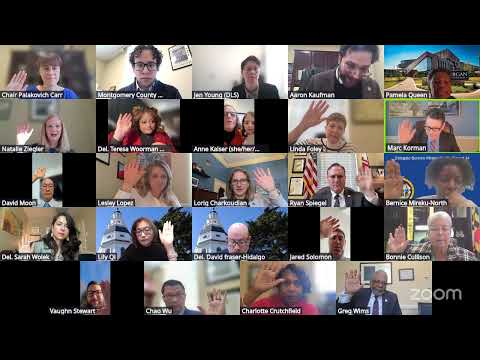
The Department of Legislative Services presented state aid data to the Montgomery County Delegation, saying Montgomery County experienced a 1.4% student enrollment decline compared with a 0.9% statewide average.
"Montgomery County's, 1.4% decline exceeds the point 9% statewide average decrease," the presenter Arnold said, citing the charts shared with the delegation. He added that approximately 47% of Montgomery students qualify for free and reduced‑price meals and that about 20% of enrollment receives English‑learner services.
Why it matters: the briefers told delegates that most state education aid is targeted to lower‑wealth jurisdictions and to specific student populations. "The vast majority of state funding has been targeted to the public school system, and the vast majority of that funding is targeted to low‑wealth jurisdictions," a DLS presenter said, explaining that roughly 70% of state aid to local governments is allocated by measures that factor in local property and income wealth.
DLS also described a revision to the free/reduced price meal enrollment count that added 33,564 students to the statewide funding counts. That change, the analysts said, reduced the projected statewide funding decrease from 9.4% to 1.7% and cut Montgomery County's projected decline from 10.6% to 2.7%—an effective increase in the count of 5,341 students for Montgomery attributable to the revised measure.
Delegates pressed DLS on the data's scope. Delegate Korman asked whether the charts included capital funding, transportation grants or agency flows such as MDOT projects or WMATA subsidies. DLS answered that the state aid report covers operating formulas that flow directly to counties and municipalities and does not include separate capital budget items or agency‑administered programs.
Several delegates also asked why neighboring Prince George's County sometimes appears to receive much higher allocations. DLS said targeted programs such as the Concentration of Poverty and the state's Blueprint initiatives direct larger shares to jurisdictions with high concentrations of deep poverty, noting that Baltimore City and Prince George's County receive large shares under those programs because of their student‑poverty profiles.
The presentation material and supplemental briefings are available on the Department of Legislative Services website, the presenters said. DLS staff invited delegates to follow up with questions and pointed to the state aid reports, session reports and local fiscal briefings posted on the DLS site for Montgomery County.