Get Full Government Meeting Transcripts, Videos, & Alerts Forever!
Get email alerts on the Wildlife Ecology topic
No spam. Unsubscribe anytime.
Researchers describe why Kiawah Island’s alligators matter to the local ecosystem
Summary
At a Town of Kiawah Island event, wildlife biologist Dr. Thomas Rainwater outlined alligator biology, nesting behavior, ecological roles and decades of local research, saying nests and gator-built denning holes create habitat used by dozens of species.
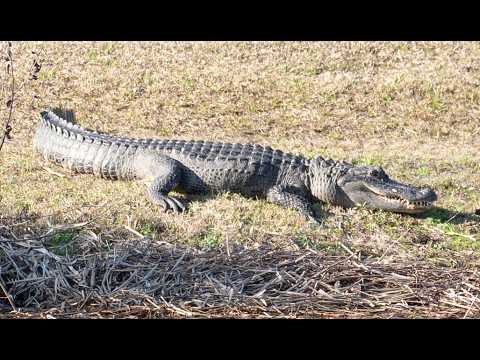
Dr. Thomas Rainwater, a wildlife biologist and research scientist affiliated with the Tom Yockey Wildlife Center and Clemson University’s Baruch Institute of Coastal Ecology, told a Kiawah Island audience that alligators are an integral component of the coastal ecosystem and a long-standing subject of field research.
"Alligators sell themselves," Rainwater said, opening a talk that traced his career back to field work on the island in the early 1990s. He summarized the species' basic biology — they are ectotherms whose body temperatures follow the environment — and explained that adult alligators are generalist, opportunistic feeders that nonetheless rely on abundant shallow-pond prey.
Rainwater described courtship and nesting on Kiawah and nearby preserves. Females build large vegetation mounds in June as nests, deposit an entire clutch in one night and incubate eggs about 65 days. He said the research teams routinely find clutch sizes around 44 eggs, with observed ranges as low as about 20 and as high as about 60.
The talk emphasized the alligator’s ecological functions. Rainwater said alligators act as apex predators that help regulate prey populations and may improve prey population health by removing weak individuals. He also described how nests and dens create microhabitats: nests open sunlight gaps that attract at least dozens of bird species and multiple reptiles and mammals, and dug dens and gator holes retain water that benefits amphibians, fish and other wildlife during dry periods.
Rainwater outlined field methods used on Kiawah and adjacent reserves: aerial surveys to locate nests, GPS mapping, careful egg handling and the use of data loggers and game cameras to study nest attendance and predator visits. He highlighted long-term mark–recapture work that permits revisiting individuals measured decades earlier, which has informed lifespan and growth research.
The presentation closed with a practical safety reminder. Rainwater urged residents to respect wildlife and keep a distance from ponds and trails, and to follow town and state guidance when encountering alligators.
The event ended with a question-and-answer session in which residents asked about bird–gator interactions, winter feeding, volunteer participation in research, nest reuse and sex-ratio influences from incubation temperature. Rainwater encouraged safe public engagement and furthered interest in ongoing island studies.