Get Full Government Meeting Transcripts, Videos, & Alerts Forever!
Get email alerts on the Airport Development topic
No spam. Unsubscribe anytime.
Consultants recommend phased airport expansion for Buckeye Municipal Airport; utilities and a 7,300‑ft runway prioritized
Summary
At a July 7 workshop, city staff and consultants presented a coordinated airport plan for Buckeye Municipal Airport (BXK) that prioritizes making the site utility‑ready, targets a 7,300‑foot runway as the recommended near‑term expansion to attract corporate aviation, and preserves options for longer runways pending committed anchor users and funding.
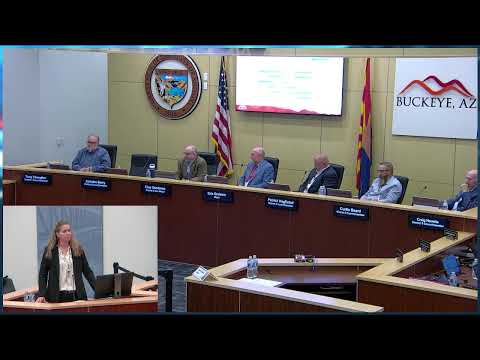
City of Buckeye staff and outside consultants used a July 7 council workshop to present a multi-pronged plan to prepare Buckeye Municipal Airport (BXK) for expanded aviation and economic development, emphasizing short‑term utility upgrades and a phased runway strategy.
Economic Development Director Susie Boyles opened the session and introduced three departmental presentations and consultants on marketing, utilities, long‑range runway concepts and an airport-specific area plan (ASAP). Ron, a Golden Shovel consultant, said BXK should aim to be “an aviation center of the West Valley” and recommended a phased approach that begins with making the site “site ready” for private investment by installing water, sewer, power, broadband and road access.
"Focus runway efforts on a 7,300 foot runway to ignite interest and attract company investors," Ron said, adding that the city should preserve the option for longer runways (8,000 feet or more) for future cargo or major MRO recruitment when anchor users or funding commitments exist.
Councilmembers probed feasibility. One councilmember asked how Buckeye compares with Goodyear and pressed staff for concrete, contract‑level steps to convert planning into deals; Ron said Golden Shovel’s role is marketing and lead generation while the city phases utilities first.
Scott Gray (Kimley Horn, presenting the utility analysis) told council that BXK has short‑term service capacity constraints: two on‑airport wells provide domestic and fire supply but offer limited fire flow; the airport relies on legacy septic systems that are near capacity for larger users; electrical capacity can support small hangars but larger manufacturing or MRO tenants will require APS upgrades; there is currently no fiber or gas service on the field. Short‑term options include optimizing the existing wells and treatment, adding an on‑airport fire tank, and using a package wastewater treatment plant or interim solutions until a permanent connection can be established.
"We do have two water wells on airport... we do have limited fire flow capacities for these two wells," Gray said, and added that staff is exploring a fiber connection along Palo Verde after the fiber owner agreed to discuss a demarcation facility.
Kaufman Associates consultant Matt Quick described the long‑range concept plan that looks beyond a 20‑year master plan and considers parallel runway options and much longer runways for high‑growth scenarios. Among alternatives under study are building around the existing Runway 17/35 alignment extended to 7,300 feet, or a Runway 10/28 alignment; in a high‑growth scenario the analysis looked at dual runways and runway lengths up to 10,500 feet to accommodate air cargo, commercial service and heavier aircraft.
"10,500 feet is the recommended length to accommodate those larger scale air cargo, commercial service, military functions," Quick said when summarizing long‑term options; he cautioned the council that airspace and noise compatibility, land acquisition and capital costs will be significant constraints and require further airspace analysis.
Principal Planner Mandy Woods described the airport specific area plan (ASAP), proposing to expand the airport activity center boundary from about 5 square miles to roughly 34 square miles (study area described as a roughly 5‑mile radius, about 86 square miles for existing conditions analysis). The ASAP is intended to guide compatible land use and zoning decisions for areas that are not yet annexed and to shape future development near the airport.
Staff and consultants said the work is iterative: additional stakeholder and public engagement is planned through the summer and fall, a public workshop on the long‑range concept is scheduled, and the consultant studies aim to return preliminary matrix findings to council in September and complete the long‑range concept by October. No formal votes or funding approvals occurred at the workshop.
Next steps: staff will continue stakeholder engagement, refine the utility needs and associated timing and costs, pursue targeted marketing and lead generation, and return to council for further decisions on runway alignment, financing strategies and the ASAP adoption timeline.