Get Full Government Meeting Transcripts, Videos, & Alerts Forever!
Get email alerts on the Strategic Plan topic
No spam. Unsubscribe anytime.
Buckeye council reviews revised 2026–29 strategic plan and sets public KPI dashboard timeline
Summary
Deputy City Manager Jared Askelson told the July 7 workshop that the city has revised focus areas for the 2026–29 strategic plan, added a housing focus area and will link measurable key performance indicators to a public dashboard; staff will return in the fall with refined KPIs to inform the budget process.
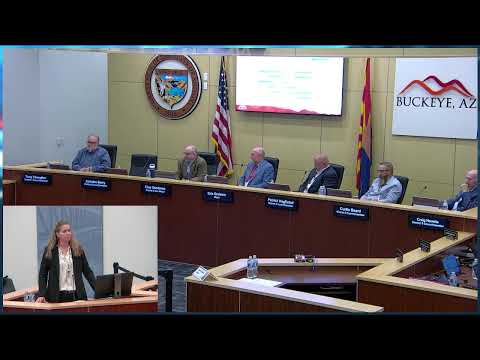
At a July 7 City of Buckeye workshop, Deputy City Manager Jared Askelson presented revisions to the city’s 2026–29 strategic plan and said staff will develop a public-facing KPI dashboard and return to council in the fall with refined targets timed to the budget process.
Askelson said the city kept five overall focus areas but retitled and refocused four of them: economic growth became “building a diverse economy,” high-performing organization became “optimizing city services through continuous improvement,” infrastructure became “investing in infrastructure,” and quality of life became “cultivating a vibrant community.” The previous separate focus on fiscal responsibility was folded into a guiding principle—“stewardship of resources”—that will underpin all focus areas. A new focus area, “ensuring high-quality diverse housing,” replaces fiscal responsibility as an explicit focus.
Why it matters: Askelson said the change is intended to make the strategic plan actionable by tying each focus area to specific KPIs and to strategic initiatives that feed those KPIs. He told council that the city will move from reporting isolated data points to defining success metrics for each focus area and reporting those on an annual, public-facing dashboard.
“We’re going to change that,” Askelson said of how KPIs are presented, adding the city will initially report KPIs for council review and then publish a public-facing KPI structure. He cited examples such as counting business licenses on a 12‑month rolling basis rather than month‑to‑month comparisons to avoid misleading seasonal fluctuations.
Council members pressed for objectivity and clarity in the measures. One councilmember cautioned against verbs that are hard to measure—“leverage,” for example—and urged staff to define measurable actions so KPIs produce decision-ready information.
Mayor Osborne stressed the need to measure whether completed projects deliver tangible public benefit: “How do we measure whether or not the public is experiencing a benefit from the projects that are being put in…?” Osborne asked, noting that surveys and other feedback loops should be timed to capture public experience when projects are complete.
Askelson said the city uses a biennial resident survey but plans to develop additional feedback loops, and that KPI work will be timed so the council reviews metrics before the 2027 budget process. Specific KPIs Askelson cited included counts of employers and jobs, commercial square footage, business licenses, sales tax collections (including lodging tax tracking for the airport), project completion rates, lane miles and a parks/facilities index; housing KPIs will include unit counts by type, average unit size and the share of cost‑burdened households.
The council did not take formal action. Staff said they will return in the fall with refined KPIs and proposals for a public dashboard that will allow year‑over‑year comparisons and clear green/yellow/red indicators tied to objective benchmarks.