Get Full Government Meeting Transcripts, Videos, & Alerts Forever!
Get email alerts on the Flood Resiliency topic
No spam. Unsubscribe anytime.
Dewey Beach committee outlines flood risk study, seeks public input
Summary
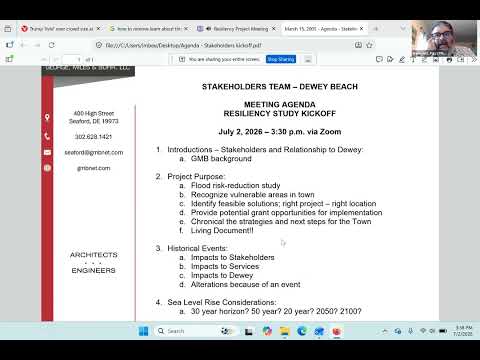
A consultant briefed Dewey Beach’s Resiliency and Sustainability Committee on a flood risk reduction study that will prioritize near-, mid- and long-term actions, solicit resident photos and impact statements, and aim to produce grant-ready documentation; a public outreach meeting is tentatively planned for September.
A consultant described plans for a flood risk reduction study to Dewey Beach’s Resiliency and Sustainability Committee and the group agreed to solicit community input and prepare public outreach materials.
Brent Jett, a professional engineer who identified himself as a certified floodplain manager, certified climate change professional and certified sustainability and resiliency professional, told the committee he will catalog past studies, prepare inundation maps and produce a prioritized list of near-, mid- and long-term projects that can be matched to funding sources. “We’re gonna try to work towards alleviating the sunny day flooding, the nuisance,” Jett said, and added that the report will aim to be practical and implementable rather than an impractical checklist.
The study will address multiple flood sources — high tides, storm surge, heavy rainfall and even water-main failures — and will quantify community impacts such as business closures and power outages so the town can make a grant case. Jett noted, “Depending on who you ask, FEMA’s rate about a dollar spent in prevention is worth about $13 in recovery,” as part of his rationale for framing prevention as cost-effective.
Committee members discussed appropriate planning horizons. The committee chair said the comprehensive plan’s 10-year timeframe should be considered; Sally, the committee’s marketing liaison, supported short and longer views and recommended 15, 30 and 50-year benchmarks. Jett said he would include near-term (two-year) actions and model intermediate horizons, adding he was already “gonna bake in an assumption that we’re gonna get another 4 inches of sea level rise in the next 5 years” so short-term planning incorporates emerging conditions. He also described the option of using an elevation target — for example, elevation 5 — as an alternative to strictly time-based projections.
The group agreed that first-hand accounts will strengthen grant applications. The chair asked Jett to circulate a brief email outlining which storm events to cite (committee members emphasized Sandy and Jonas as useful baselines) and what stakeholders should describe about impacts (depth/duration of flooding, loss of power, employee absences). Jett requested residents submit photos, including older images, to help georeference historic flood locations and identify vulnerable spots.
On public engagement, Jett proposed pairing his exhibits with a public meeting during town hall’s September opening rather than holding a standalone session. He recommended using visual inundation maps in outreach so residents can confirm or correct the consultant’s engineering view. The committee named Deborah, the committee chair and Sally as primary points of contact to collect materials and coordinate outreach; Bill, the town manager, said timing will depend on logistics and deferred specific event scheduling to the mayor.
Jett said the report will consolidate prior reports, GIS overlays and projections, include appendices with data sources and show what one and two feet of inundation would look like across town. The deliverables will prioritize low-cost, near-term actions where feasible and identify longer-term capital needs tied to estimated costs and potential grant programs.
Next steps: Jett will compile exhibits and a short email template for collecting incident descriptions and photos; committee members will solicit inputs by email and plan to reconvene in late July or early August if needed. The committee also discussed a possible public outreach session in September to share preliminary exhibits and collect feedback.
The committee ended the meeting with agreement to proceed by email where possible and to schedule an in-person meeting if necessary to review exhibits and community input.