Get Full Government Meeting Transcripts, Videos, & Alerts Forever!
Get email alerts on the Wildlife Management topic
No spam. Unsubscribe anytime.
Woodstock adopts local law to curb human–bear conflicts after public hearing
Summary
Town Board held a public hearing and adopted a local law aimed at reducing human–bear conflicts by requiring mitigation of bear attractants and establishing escalating fines for repeat violations; supporters emphasized education plus penalties, and the board directed filing of the local law with the state.
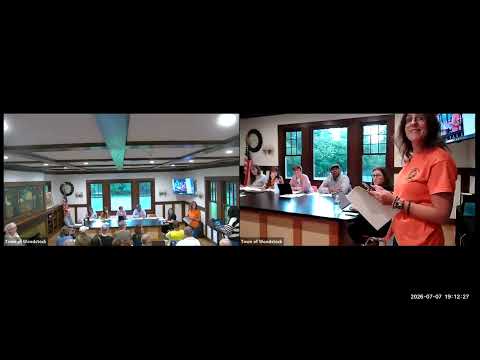
The Town Board of Woodstock opened a public hearing on July 7, 2026, on a proposed local law to reduce dangerous interactions between people and bears and then adopted the measure later in the meeting.
At the hearing, task force members and residents urged a combination of outreach and enforceable penalties to address repeat problems. Rachel Reyes Jackson of the Woodstock Bear group said education has reduced complaints but “education works for most of us, yet it doesn't work for some of us,” arguing the ordinance would “level the playing field” by addressing persistent noncompliance.
Speaker 1, who led the meeting, explained the law focuses on mitigating outdoor food and waste that attract wildlife and noted the town’s bear task force has been working for years to educate the public. The proposed law includes a graduated fine schedule (first offense $100, second $200, third $300) and gives local enforcement and code officers discretion to pursue warnings or fines.
During public comment, residents asked how the ordinance would work with DEC/DEP-approved receptacles, whether signage or materials would be distributed to short-term rental managers, and how fines would be processed. Speaker 1 replied that enforcement would use existing building-violation processes, with collected fines routed through the building department and town clerk’s office to the bank.
After receiving public comment, the board read and adopted a resolution finding a negative declaration under the state review code and adopting the local law to create Article 3 of Chapter 14 of the Town of Woodstock code to minimize human–bear interactions. The clerk was directed to file necessary environmental findings and to transmit the local law to the state secretary of state per the municipal code.
The law’s text and the short environmental assessment form are filed with the town clerk and available per the board’s instructions. The board recorded the adoption action as approved; individual roll-call votes were not read aloud during the public record of this meeting.
The town said the new ordinance is intended to pair education resources from BearWise and the bear task force with a mechanism for addressing repeat violations so that voluntary compliance is reinforced by enforceable consequences.