Get email alerts on the Infrastructure topic
No spam. Unsubscribe anytime.
Council authorizes $10.26M (plus operations) AMI water‑meter replacement contract
Summary
Pleasanton authorized agreements to replace failing water meters with an advanced metering system, approving contracts not to exceed the capital and operating totals presented and a 5% contingency to meet state deadlines and a Zone 7 settlement; council emphasized tight timelines for proof‑of‑concept and full implementation.
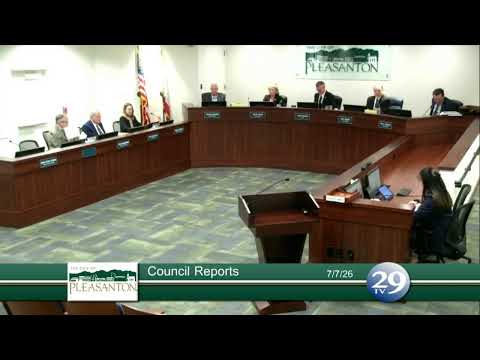
The Pleasanton City Council unanimously authorized agreements July 7 to replace the city’s failing water meters with a new advanced metering infrastructure (AMI) system and to enter contracts with equipment and services providers.
Staff told the council the city is experiencing widespread meter failures (roughly 300 per month, with about 2,200 failed meters awaiting replacement) and that the work is required under a July 2025 settlement agreement with Zone 7 and by state regulatory deadlines. The proposed procurement calls for Camstrup ultrasonic meters (with stated warranties) and agreements with Core & Main LP for meters, software and network services.
Staff described a planned proof‑of‑concept and testing phase to run through October, followed by phased installation. In the first implementation phase, staff said it intends to replace the ~2,200 currently failed meters plus roughly 3,500 additional meters. The goal stated in the presentation is to meet state requirements by December 2027 and the settlement’s June 2028 deadline.
The staff report included maximum not‑to‑exceed amounts for capital and operations: staff announced at the meeting an amount "not to exceed $10,262,257 for capital improvements and approximately $2,500,000 for operations" and recommended authorizing a 5% aggregate contingency. (The staff presentation later included slightly different numeric formatting in the transcript; the staff report should be consulted for precise contract line‑items and budget allocations.)
Council members asked implementation and timing questions, and staff explained that a proof‑of‑concept is intended to validate meter accuracy, data transmissions and integration with City systems before broad field deployment. Councilmember comments stressed the necessity of the project for reliable water operations and revenue protection.
Councilmember Eicher moved to approve staff’s recommendation to enter the agreements and to authorize change‑order authority for the director of public works up to the stated contingency; the motion was seconded and passed unanimously.
Staff said they will return with the executed agreements and begin proof‑of‑concept testing immediately, aiming to complete initial validation and then move to full implementation. Staff noted outreach to Zone 7 during the selection process and that Zone 7 declined to participate in the meter selection, though city staff has shared technical documentation with Zone 7 as part of settlement compliance efforts.
Council asked staff to track schedule risks and potential additional costs if implementation timelines slip; staff acknowledged the tight schedule and the possibility of cost impacts if deadlines are missed.
AI generated
The text on this page is AI generated. Summaries, highlights, analysis, and video transcripts are all produced from the original source material.
AI can make mistakes, so if you spot one, and we will fix it for everyone.
Note: the source content is unaltered by us. Any content source we link to, be it a video, an audio recording, or a document, is presented exactly as its publisher released it. That publisher is usually a government body, sometimes an individual official or another organisation.