Get Full Government Meeting Transcripts, Videos, & Alerts Forever!
Get email alerts on the Public Works topic
No spam. Unsubscribe anytime.
Newcastle officials outline plan for joint public‑works department and propose November ballot question
Summary
Town manager Kevin presented a draft interlocal agreement to create a joint public‑works department with a neighboring town, saying startup costs would be higher but the working group’s model projects long‑term savings; residents raised questions about assumptions, staffing and service priorities.
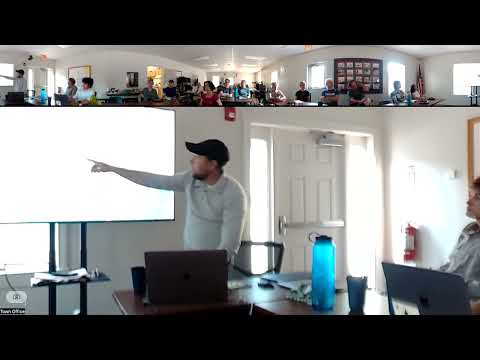
Town manager Kevin told residents at a July public meeting that Newcastle and a neighboring town are exploring an interlocal joint public‑works department that would shift routine road maintenance, ditching and other operational work from contractors to a single shared municipal entity.
Kevin said the working group developed cost models showing higher upfront startup and equipment costs but a projected breakeven in the medium term (examples shown: breakeven near year seven under the standard scenario and later under premium staffing scenarios). Under the draft interlocal agreement the two towns would create a quasi‑municipal public‑works entity governed by a six‑member oversight board (three members from each town); town managers would serve as non‑voting professional advisors and the board would appoint a director to manage daily operations.
The draft agreement preserves local budget authority: annual operating and capital budgets would still be approved by each town’s select board and by voters where required, Kevin said. He described the managing municipality as the employer of record (one town would be the employer for department staff) and said the agreement would include withdrawal provisions that require a withdrawing town to carry its share of outstanding debt for capital investments.
Residents pressed for detail. Rachel said the presentation “felt like a grossly positive spin” and questioned line‑item assumptions; she asked whether outside benchmarks and public‑works directors from comparable towns had reviewed the budgets. “People that try to offer powers to be about the numbers and their inaccuracies have been completely overlooked,” she said.
Kevin responded that the working group produced the budget with input from select‑board members and that staff plan direct follow‑up conversations with public‑works directors in peer towns and further review of line items. He described a prototype online tool (built during the project) that allows residents to compare service‑level options and cost forecasts.
Several participants raised operational concerns. Justin, who described public‑works experience, warned that hiring and retaining drivers and plow crews is difficult and that staff burnout after several winters could force continued contracting for some work. Kevin said the draft budget recognizes staffing risk and that, if necessary, some work could still be contracted while the new department ramps up.
Kevin said the select boards did not put the measure on the June ballot and that the working group now intends to seek a November ballot question to authorize step‑one approval of the interlocal agreement and limited planning funding. If voters approve that initial step, further decisions — including site selection, capital funding, land acquisition and borrowing — would return to each town for separate approvals. Kevin emphasized that the interlocal agreement itself would not authorize land purchase or construction and that separate votes would be required for capital commitments.
Next steps include additional outreach, conversations with peer public‑works directors, refinement of the cost‑share formula and an informational campaign before any November question. Kevin asked residents to review the linked materials and provide feedback to the working group.