Get Full Government Meeting Transcripts, Videos, & Alerts Forever!
Get email alerts on the Environmental Conservation topic
No spam. Unsubscribe anytime.
Presenter outlines seagrass mapping and conservation work in Barnegat Bay
Summary
A field presentation near Beach Haven described Phase 2 verification for a statewide seagrass mapping effort, highlighted eelgrass and widgeon grass characteristics, warned that boat propellers and wakes can cause long-lasting damage, and urged boaters to avoid shallow meadows.
A presenter conducting field verification near Beach Haven, New Jersey, described a Phase 2 effort to map and monitor seagrass meadows in the Barnegat Bay–Little Egg Harbor estuary and urged local boaters to avoid shallow seagrass habitat.
The presenter said the Barnegat Bay–Little Egg Harbor estuary contains about 80% of New Jersey’s seagrass habitat and described seagrasses as “flowering plants with a vascular system” that grow entirely underwater except during brief low-tide exposures. The program’s conservation work is focused on two species: eelgrass and widgeon grass.
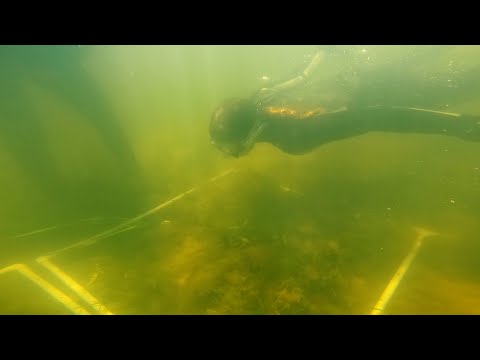
The mapping effort combines field verification and newer satellite imagery. In the field, crews place an 8-grid quadrat at established stations and use two divers to estimate percent coverage of seagrasses, macroalgae and bare sediment; data will be used to update maps created in 2023. The presenter said this Phase 2 work is intended to identify areas suitable for potential restoration and to inform ongoing monitoring.
The presenter provided species details: eelgrass often has ribbonlike leaves that can reach about 1 meter long and 2–12 millimeters wide, with leaf form varying by sediment type and water depth. Widgeon grass was described as having threadlike leaves about 3–10 centimeters long and roughly 0.5 millimeter wide and as having a broader salinity tolerance than eelgrass.
Seagrass meadows were described as providing habitat for recreationally and commercially important shellfish and finfish and as protecting shorelines by damping waves and currents. The presenter cautioned that “direct impacts such as contact from boat propellers and strong boat wakes can damage or scour seagrass meadows,” and added that recovery can take many years. The presenter closed by advising boaters to watch for seagrass meadows in shallow waters this summer.
The presentation did not identify the program by a formal agency name in the transcript; technical details supplied in the field—measurement methods, 2023 baseline maps, and the shift to including satellite imagery—are part of the program’s stated approach to mapping and restoration planning.