Get Full Government Meeting Transcripts, Videos, & Alerts Forever!
Get email alerts on the Municipal Procurement topic
No spam. Unsubscribe anytime.
Presenter explains how to win city contracts — and why vendors must not start work before a contract
Summary
A single-presenter explainer walks vendors through the city procurement lifecycle, defines RFQ/ITB/RFP/RFQC solicitation types, differentiates responsiveness from responsibility, explains bid bonds and E-Verify requirements, and warns vendors to wait for a written purchase order or executed contract before starting work.
A presenter offering an explainer on municipal procurement outlined the full life cycle of a city contract and urged vendors never to begin work until the city issues a written authorization.
"A recommendation for an award is absolutely not an authorization to start working," the Presenter said, emphasizing that only a fully executed contract or a formal purchase order allows work to begin without financial risk to the bidder.
The presentation mapped procurement into six steps: departments identify needs and secure funding; the purchasing division issues a solicitation; vendors submit responses; the city evaluates responses; an award recommendation is issued (sometimes requiring city council consent); and the contract is executed. The Presenter said purchases above a specified threshold must be routed to the council for approval before execution: "purchases over $200,000 have to go all the way to the city council," he said.
Why it matters: many competitive bids are disqualified for procedural reasons, not price. Vendors who misunderstand solicitation types or miss administrative requirements can lose despite offering the lowest price.
Solicitation types and when they apply
The Presenter defined four common solicitation methods and when each is used. An RFQ (request for quotes), he said, is typically used "when needs are clear, usually for purchases between $5,000 and $100,000," and awards go to the lowest responsive and responsible quote. An ITB (invitation to bid) covers purchases with crystal-clear specifications where price is the main differentiator and likewise favors the lowest responsive and responsible bidder. By contrast, an RFP (request for proposals) is used when the city seeks a tailored solution and evaluates proposals for "best overall value," weighing technical approach and experience. The RFQC (request for qualified contractors) is a prequalification step that selects vendors based on qualifications and past performance before price enters consideration.
Responsiveness vs. responsibility
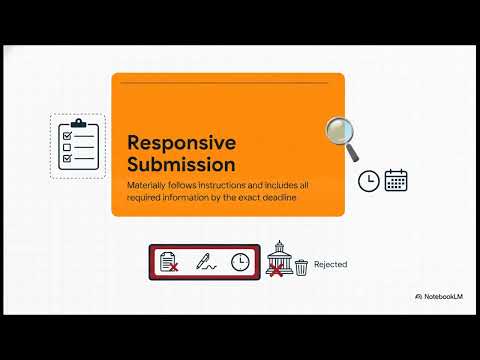
The Presenter described two separate standards vendors must meet. Responsiveness requires strictly following the solicitation instructions, submitting every required form and signature, and meeting the deadline — "If you miss a required signature or if you hit submit even 1 single minute late, your bid is considered nonresponsive." Responsibility is the city's verification that a vendor can actually perform the work, demonstrated through licensing, insurance, financial capacity, and prior performance. He stressed both are necessary: the lowest price cannot win if a vendor fails either test.
Preparing a compliant submission
Vendors were urged to treat the solicitation checklist as mandatory: complete every form, use the exact pricing format, include mandatory certifications (the Presenter cited the E-Verify affidavit as a work-authorization requirement in Georgia), include licenses, and explicitly acknowledge any addenda. The Presenter singled out the bid bond when applicable as a common stumbling block: "When it's applicable, this is a 5% financial security requirement that protects the city if a bidder refuses to actually honor their bid," and noted accompanying documents — such as the power of attorney and proper bid certifications — are required to make a bond valid.
Practical steps recommended included attending pre-bid meetings and site visits to understand field conditions, asking questions early and before the stated deadline, and relying solely on written addenda for clarifications. The Presenter warned that verbal answers carry no binding authority: addenda are the official record.
Common, disqualifying mistakes
The Presenter listed repeated errors that lead to immediate disqualification: late submissions (no exceptions), missing documents or signatures, failing to read the scope of work, ignoring addenda, adding unauthorized exceptions to city contract terms, and contacting city staff outside the designated purchasing division contact.
Evaluation and award
After submission the city runs a sequence of checks: timeliness, responsiveness, responsibility verification, and then evaluation according to the published criteria. The Presenter noted the approval process may require additional sign-offs for larger purchases and reiterated the council-review threshold for items above $200,000. He also explained how evaluation criteria vary by solicitation method: ITB/RFQ assessments focus on price among responsive/responsible bidders, while RFP/RFQC reviews assign scores to technical approach, experience, staffing, and schedule to determine best overall value.
Final warning and takeaways
The Presenter repeated the pivotal caution that vendors should not start work or spend money based on a notice of intent or recommendation to award. "Never start work or spend a dime until you have a fully executed contract and a written authorization to proceed, like a formal purchase order," he said.
He closed with a rapid-fire checklist for stronger bids: read the solicitation early, follow instructions exactly, ask questions before the deadline, review addenda, avoid unapproved exceptions, include every required document, and submit on time. The Presenter framed the process as designed to protect public funds while enabling fair competition and encouraged vendors to use these practices to improve their chances on future solicitations.