Get Full Government Meeting Transcripts, Videos, & Alerts Forever!
Get email alerts on the Subdivision Modification topic
No spam. Unsubscribe anytime.
Board agrees change of circumstance exists for Drum subdivision; asks for survey and accessory-structure details
Summary
The Planning Department and applicant argued that an unopened paper road no longer affects the Drum Minor Subdivision building envelope. The board agreed a change of circumstance exists, signaled support for modifying the envelope and covenants in concept, and requested a survey showing the proposed envelope and details for accessory structures to determine permitting needs.
The board signaled support on July 8, 2026, for the concept of modifying the building envelope and covenants for a Drum Minor Subdivision lot approved in 2001, but asked the applicant to supply a survey and details for accessory structures before any formal action.
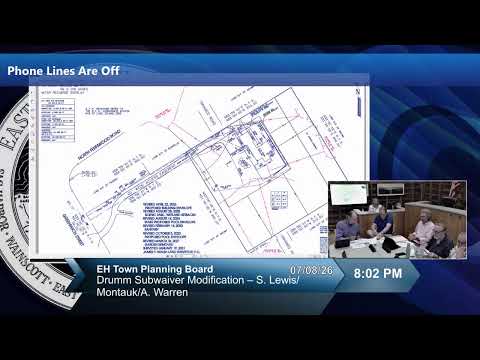
Planning staff explained the application seeks a modification to the building envelope and covenants and restrictions to legalize accessory structures (fences, gates, low walls, pedestrian walkways) that were constructed outside the approved envelope. Staff presented historic maps and tax records and said the original envelope design appears to have been influenced by an unopened paper road that, because adjacent parcels are now town-owned preserved land, can no longer be opened as originally intended. Staff said that change in circumstance might justify reconsidering the envelope.
Thomas Crouch, attorney for the applicant, confirmed the objective is to legalize existing accessory structures and presented a proposed envelope on a survey he had submitted; he asked the board to allow accessory structures to remain outside the envelope provided any NRSP (Natural Resource Special Permit) or variance relief is obtained through the appropriate boards. Planning staff advised that expanded envelope areas should generally exclude NRSP jurisdiction to protect wetlands; the applicant pushed back but acknowledged that NRSP variances or other relief would still be required if structures fall within those jurisdictions.
The board agreed a change in circumstance exists and that the applicant should supply a survey showing the proposed building envelope and wetland setbacks. Members also requested that the applicant provide design, height, and setback details for accessory structures proposed to remain outside the envelope so that the board and other review bodies (Zoning Board of Appeals, Architectural Review Board, Natural Resources) can identify necessary approvals.
Next steps: Applicant to submit the survey showing the proposed envelope and wetland setbacks, and to document accessory-structure details. Any accessory structures within NRSP areas will still require appropriate relief from other boards.