Planning board leaves Most Holy Trinity Cemetery modification open pending natural-resources input
Summary
The church's application to remove invasive bamboo and giant cane from a 20-foot nondisturbance buffer was not approved. Applicants cited entwined rhizomes in tree roots and reluctance to remove mature trees; the board asked for a revised remediation/revegetation plan and Natural Resources department comments.
The East Hampton Planning Board on July 8, 2026, did not approve a proposed modification for Most Holy Trinity Cemetery to remove invasive bamboo and giant cane from a 20-foot-wide nondisturbance buffer, and asked the applicant and staff to provide additional technical plans and natural-resources input.
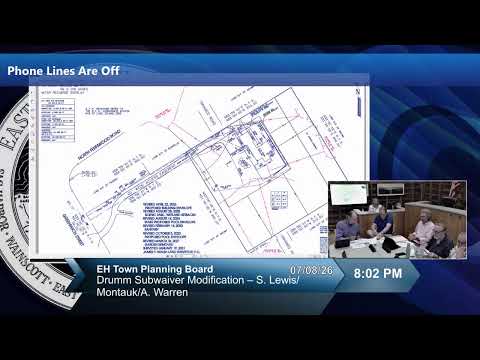
Planning staff introduced the modification as a request to remove invasive species from the cemetery's southern nondisturbance buffer. The site, roughly 9.39 acres, lies within the South Fork Special Groundwater Protection Area and is identified as a historic cemetery in town records; staff noted groundwater-recharge concerns and that a public hearing was held June 17, 2026.
An applicant email dated June 29 asked to remove previously proposed plantings because bamboo and giant cane often require multiple removals and are difficult to eliminate; the submittal recommended that temporary ground cover such as grass or clover could stabilize disturbed areas if replanting is impractical. Patrick Hynes, speaking for the church, explained the rhizomes of bamboo and cane are attached to tree roots among about 48 trees in the 20-foot buffer. He said full eradication would require removing trees and stumps, which the church does not intend to do, so any mitigation is likely to involve ongoing maintenance rather than one-time revegetation.
Board members and staff raised concerns about the site's groundwater-protection status and emphasized the ecological value of ground cover for recharge and filtration. Eric Shantz (Planning Department) said staff would consult the Natural Resources unit for revegetation expertise and possible alternative plant palettes; he reiterated that planting need not be bayberry specifically and suggested drought-resistant grasses that do not require irrigation as a possible interim measure. Several board members expressed skepticism that standard revegetation over bamboo would succeed without a specialized plan.
Outcome: The Planning Board concluded the application is not ready for approval. The board requested a revised partial site plan and a remediation/revegetation approach informed by Natural Resources staff; whether a second public hearing is needed will depend on the scope of the revised submission.
Next steps: The applicant — who said the church will continue to remove accessible bamboo while avoiding disturbance to tree roots — should coordinate with the Planning Department and Natural Resources to produce a detailed plan that addresses groundwater-protection concerns and practicable revegetation options.
AI generated
The text on this page is AI generated. Summaries, highlights, analysis, and video transcripts are all produced from the original source material.
AI can make mistakes, so if you spot one, and we will fix it for everyone.
Note: the source content is unaltered by us. Any content source we link to, be it a video, an audio recording, or a document, is presented exactly as its publisher released it. That publisher is usually a government body, sometimes an individual official or another organisation.