Get Full Government Meeting Transcripts, Videos, & Alerts Forever!
Get email alerts on the Election Administration topic
No spam. Unsubscribe anytime.
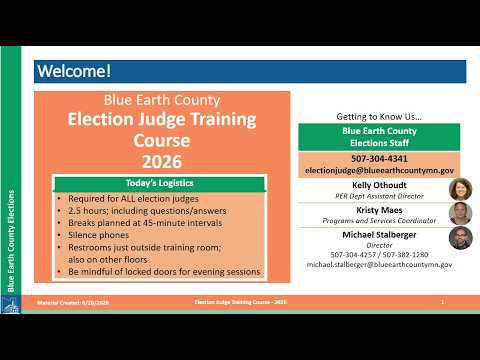
Blue Earth County outlines Election Day rules for judges in training video
Summary
A Blue Earth County training video for election judges details who may access polling places, media credentialing and recording rules, challenger and vouching procedures, poll-pad check-in and tabulator handling, and forbidden campaigning within 100 feet of polling sites.
Blue Earth County’s Elections Office released an Election Day training video for election judges that reviewed who may be in polling places, how to handle credentialed observers and challengers, procedures for curbside voting and Election Day registration, and prohibitions on campaigning.
The presenter told judges that these videos are a refresher and “are not an alternative to the in-person training,” and directed anyone who has not completed in-person training to contact the county elections office. The video emphasizes that access to the polling place is limited to appointed election judges and people actively involved in voting; other authorized persons must be credentialed by the head judge.
On media access, the presenter said members of the media may be credentialed by the head judge and “are allowed to observe the voting process” provided they maintain a six-foot buffer from voters, refrain from interfering or conversing with voters, and do not disclose private voter information or compile lists of who voted. Exit-poll interviewers, the video explained, may operate near exits but also must be credentialed.
The video described challengers as a narrow, high-bar role: challengers may only personally challenge a voter’s eligibility based on personal knowledge, must be appointed by one of the major political parties or a candidate and must be credentialed by the head judge. Presenter guidance reiterated challenger limits (one per major party at a time, and one per candidate if appointed) and prohibited challengers from making lists of voters, handling election materials, or using phones in the voting room.
On voter assistance and party balance, the presenter said voters may get help from any person of their choosing so long as that helper is not an employer or union representative; judges should not collect names and must ensure partisan balance when a judge marks a ballot for a voter.
The video walks judges step-by-step through poll-pad check-in and Election Day registration. Judges are told to verify the voter’s precinct and identity using the fewest characters when searching poll pads, to have voters sign an on-screen oath, and to retain the printed receipt that ties a voter to a precinct and school district. Acceptable proofs of residency and identity listed include Minnesota driver’s licenses or ID cards, tribal IDs, utility or bank statements, leases, and student IDs with photos; the presenter reminded judges that documents must match the voter’s name and be current within 30 days when required by the poll-pad prompts.
When standard documentation is not available, the presenter explained vouching options: a registered precinct resident may vouch for up to eight new registrants by signing an oath, and employees at qualifying residential facilities (nursing homes, assisted living, veterans homes, supervised living, homeless shelters and similar facilities) may vouch for an unlimited number of voters who reside at that facility, after authenticating with a head-judge-reviewed ID.
The video also covers ballot security and tabulator use: ballot packs must be opened and initialed by two judges, tabulator judges should ensure only precinct ballots are counted and remain near machines while preserving voter privacy, and the procedure for spoiled ballots requires documenting the spoiled ballot and issuing an identical blank replacement for revoting.
On campaigning, the presenter defined campaign materials and speech (candidate names, logos, slogans, pictures, or other identifying information about candidates, parties or ballot questions) as prohibited inside polling places and on public property within 100 feet of polling places. Judges are instructed to ask individuals to remove or cover materials or to leave; if a person refuses, the head judge documents the refusal on the incident log and may refer the situation for possible investigation or charging while ensuring the individual still has the right to vote.
The presenter reminded judges that phones may be used by voters but not to record other voters or compile lists; election judges themselves should not display phones to voters while working and should step outside the voting room to make personal calls.
The video concludes by directing judges to additional Blue Earth County training materials at blueearthcountymn.gov/elections and to use the county feedback/incident forms for complaints or commendations. The presenter told judges not to handle notarized complaint forms themselves and explained options for returning such forms to the county office or law enforcement when appropriate.
The video is explicitly a training refresher; it does not enact policy changes and reiterates that in-person training remains a requirement for serving as an election judge in Blue Earth County.