Get Full Government Meeting Transcripts, Videos, & Alerts Forever!
Get email alerts on the Employee Benefits topic
No spam. Unsubscribe anytime.
Brazos County court directs staff to limit employee health-premium increase to 5%
Summary
At a July 7 workshop the Brazos County Commission Court directed staff to proceed with an option that caps employee premium increases at 5% for the coming plan year while the county absorbs the remaining projected increase amid rising medical and prescription costs.
At a July 7 workshop, the Brazos County Commission Court directed staff to implement an employee premium limit for the next health-plan year, choosing an approach that caps employee premium increases at 5% while the county absorbs the remainder of a projected rise in medical and prescription costs.
Jennifer presented four premium-coverage options and described the financial context: the county offers a comprehensive PPO plan, employee premiums have been unchanged for several years, and national trends — including rising utilization and higher prescription costs — are putting upward pressure on the plan. "This option limits employee premium increases to 5% with the county absorbing the remaining increase necessary to fund the plan," Jennifer said of the court's chosen approach.
Nina Payne, the county budget officer, told the court the county's health-and-life fund balance is shrinking. "This year's fund balance was estimated 10,000,000," Payne said, adding that the county auditor projected next year's fund balance to be about 8,000,000 and that the fund has been declining by roughly $2,000,000 annually. Payne said those figures underlie her recommendation to adopt the 5% cap for the coming year. "My recommendation ... would be to do the 5% to the county employees for this year," Payne said.
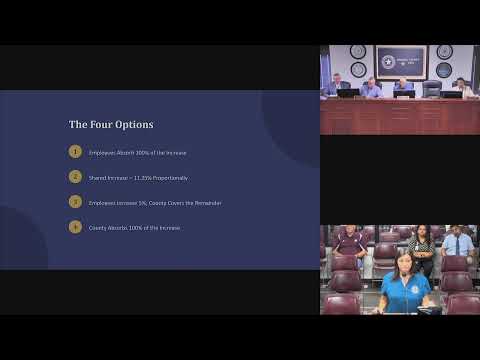
The court discussed four options Jennifer presented: Option 1 would have employees absorb the full projected increase; Option 2 would split the increase between the county and employees; Option 3 would limit employee increases to 5% (county covers the remainder); Option 4 would have the county absorb the full projected increase so employee premiums remain unchanged this year. Commissioners repeatedly described Options 1 and 4 as undesirable and framed the real choice as between Options 2 and 3.
Members asked for and received basic dollar comparisons. Jennifer and other participants said the projected increase equated to about an 11.25% change relative to the county-contribution reference point; that translated to roughly $7 a month for employee-only coverage under one split scenario versus about $3 a month under the 5% cap, and about $79 per month for employee-plus-family under Option 2 versus about $35 under Option 3. Jennifer also confirmed that retirees who were employed prior to 08/03/2011 would see their premiums increase to match the employee rate under the adopted approach.
Court members emphasized the difficulty of the choice and the need to revisit the issue. One member cited high-cost prescription drugs, including GLP‑1 therapies, as a material driver of rising plan costs. Several members said a softer, shared approach was preferable for the coming year, with the intent to reexamine the plan in the next budget cycle.
Jennifer summarized the court's guidance and confirmed next steps: "Then that's our direction, and we'll proceed with Option 3," she said. No formal vote was taken during the workshop; the court provided direction for staff to implement the 5% cap and produce the necessary administrative steps. The court briefly moved on to the FY 26-27 county budget scheduling and adjourned the workshop.
What happens next: staff will proceed under Option 3 and return with implementation details and any budgetary adjustments in subsequent meetings, and the court indicated it will review the approach again during the next budget cycle.