Get Full Government Meeting Transcripts, Videos, & Alerts Forever!
Get email alerts on the Racial Equity In Clean Energy topic
No spam. Unsubscribe anytime.
Race Forward trainers urge municipal staff to bake racial equity into clean-energy programs
Summary
In a MAPC webinar, Race Forward facilitators Tony Patillo and Dan urged municipal staff to move beyond technical approaches and embed racial-equity analysis in clean-energy planning, citing historical government roles, four levels of racism, and concrete energy-sector examples such as Mass Save participation, EV access, and rooftop solar uptake.
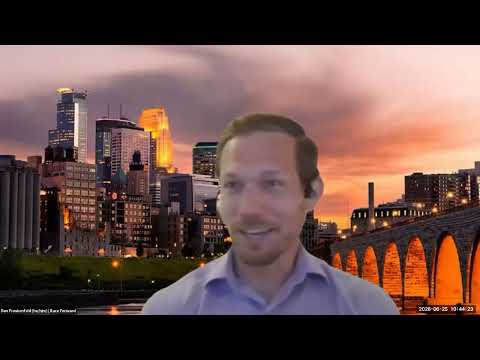
Tony Patillo, a trainer with Race Forward, and Dan, a facilitator with Race Forward, led a virtual workshop for municipal staff on integrating racial equity into clean-energy programs, arguing that policy design and implementation shape who benefits from climate investments.
Patillo opened by saying race is a primary driver of outcomes in the United States and urged participants to treat race as a social construct that nonetheless produces measurable disparities. "Race is the number 1 driver for outcomes," he said, illustrating the point with an example from his work in emergency medical services where certain ZIP codes showed worse cardiac-arrest outcomes for Latino and Black men after racial-equity analysis. He framed the session around practical tools municipal planners can use to identify leverage points in departments and programs.
Dan outlined a four-part framework—internalized, interpersonal, institutional and structural racism—and applied it to the energy sector. He said internalized beliefs can keep historically disinvested residents from seeking rooftop solar or efficiency programs, while interpersonal bias can lead utility staff to explain financing options more often to white homeowners. "If systems are operating on cruise control, removing individual bias is necessary but not sufficient," Dan said, arguing that data disaggregation and policy change are needed for lasting outcomes.
Both facilitators used historical prompts—quotations such as "all men are created equal" and the Pledge of Allegiance—to surface how government narratives, laws and policies have excluded people over time. Patillo noted past government actions that, in his view, redirected reparative resources toward enslavers rather than formerly enslaved people, and urged participants to examine how policy choices continue to shape who benefits from programs today.
The trainers gave specific municipal examples that implicate clean-energy equity: Mass Save participation that skews toward predominantly white neighborhoods; lack of EV charging access for residents of multifamily buildings; and financial barriers that limit rooftop solar to homeowners with equity and credit access. They encouraged a "race-and" analysis that considers race alongside neighborhood, immigration status, income and other identities to reveal intersecting barriers.
Recommended strategies included culturally grounded supports and racial-healing work for internalized racism, cross-cultural dialogues for interpersonal issues, and institutional reforms—such as norming data disaggregation by race, conducting root-cause analyses, and embedding equity into policies—so those changes become durable rather than optional.
Facilitators closed by inviting participants to share examples from their own municipal work and reserved time for audience Q&A and discussion of local choice points. The training was hosted as a compressed session of material Race Forward typically delivers over many months, aimed at giving municipal staff practical next steps to align clean-energy initiatives with racial-equity objectives.