Get Full Government Meeting Transcripts, Videos, & Alerts Forever!
Get email alerts on the Winter Maintenance topic
No spam. Unsubscribe anytime.
Sawyer County warns winter-salt costs could nearly double; highway staff propose salt–sand mix, brine study and facility options
Summary
Highway staff told the Sawyer County Public Works Committee that a spike in rock-salt prices and a planned 4,200-ton purchase could push the winter-maintenance budget from about $712,000 to nearly $1,000,000 and urged the board to consider salt–sand mixes, brine and consolidation of facilities to control costs.
Highway staff told the Sawyer County Public Works Committee that rising rock-salt prices and larger-than-normal purchases are driving winter-maintenance costs sharply higher, and presented short- and long-term options for trimming expenses.
"Our winter maintenance budget's around $712,000... I've increased it this year and you haven't seen it yet, but almost up to 1000000 dollars," said John, identified in discussion as the highway staff lead. He said the county must order about 4,200 tons of salt and that the current salt price is roughly $109.74 per ton, which alone could amount to nearly $500,000.
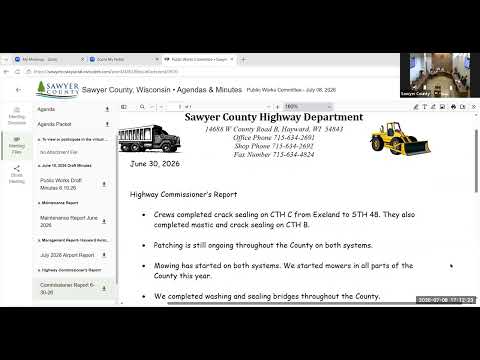
The details matter because staff also reported active summer and fall work that depends on available crews: crack sealing and mastic on County Road C, three culverts completed on County F and DD, roughly 3 miles pulverized on County F with paving expected once a nearby plant resumes operations. Highway staff said the paving plant moved to Douglas County and staff now expects paving to start around Aug. 10.
Why it matters: the committee must reconcile ongoing roadwork and capital needs with a winter budget that may substantially exceed prior years. Highway staff recommended several cost-control approaches: using a 50/50 salt–sand mix on lower-ADT roads, pre-wetting or brine to reduce pure salt use, targeted salting on primary routes, and considering a brine facility or other equipment (trucks, brine makers) as longer-term investments. Staff cautioned that switching technologies requires upfront capital and may not yield immediate savings.
Committee members pressed practical trade-offs. One member said targeted salt–sand mixes could reduce costs and phone complaints; another cautioned about safety and storm-to-storm variability. John said he could research comparative numbers from other counties and return with cost estimates for brine and facility options; members asked staff to present multiple scenarios.
Other highway items noted in the same report included right-of-way appraisals for a county acquisition (legal negotiation ongoing), Triple River bridge approach work on County D expected to be open by July 30, and a public involvement meeting scheduled July 13 for the Radisson–Winter road segment. Staff said they notified emergency management and local stakeholders but avoided committing to a strict timeline because contractor schedules can change.
The committee did not vote on a specific winter-maintenance policy at the meeting; members directed staff to gather comparative costs and develop multiple options for future action.