Get Full Government Meeting Transcripts, Videos, & Alerts Forever!
Get email alerts on the Commercial Redevelopment topic
No spam. Unsubscribe anytime.
Consultants outline residential/commercial financial model and urge community input
Summary
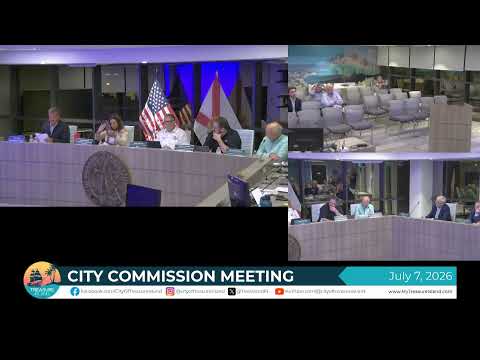
Consultants from Raftalis presented a financial analysis approach July 7 to Treasure Island commissioners, showing how a residual‑land‑value model will test what development types and densities can pencil out and urging residents to complete a master‑plan survey and attend upcoming community meetings.
A team from Raftalis presented a technical but pragmatic overview of a financial analysis model meant to guide Treasure Island’s commercial redevelopment master plan at the July 7 commission workshop. Consultant Cheryl (Raftalis) and chief economist Steven McDonald described the model as a residual‑land‑value, pro‑forma‑style tool designed to show how market revenues, construction costs and local land‑use constraints affect whether a proposed development is financially feasible.
McDonald emphasized that economics is a social science and that the model won’t produce a single “right” answer. He said the model is intended to help staff and the commission test scenarios — for example, how changing allowable height, parking rules or construction quality would alter project profitability and the amount a developer can afford to pay for land. McDonald illustrated that modest changes to inputs (rents, vertical construction costs or taxes) must be modeled holistically because they interact across revenues and costs.
Why it matters: Treasure Island’s small land area and dense lodging market make the local development market sensitive to changes in product mix, he said, cautioning that investors will look regionally (Reddington Shores to St. Pete Beach) when making decisions. The consultants said this thin‑market reality could make it harder for pure commercial projects to pencil without public action or incentives.
Consultants flagged next steps that will feed into a draft commercial redevelopment master plan: a resident survey (540 responses reported by 2 p.m. on July 7), four community meetings (July 27, July 28, Aug. 3 and Aug. 5) and a broader community visioning session in late August or early September. Cheryl said a draft master plan is expected in mid‑October with a November presentation and an adoption hearing by year‑end.
Commission response and follow‑up: Commissioners asked that the model be presented in ways that are understandable to staff, elected officials and residents; the consultants promised scenario runs tied to specific parcels and training sessions to help the commission and staff use the tool. The consultants also agreed to run parcel‑specific scenarios using current city codes and alternative inputs so the city can see whether current regulations would allow economically feasible redevelopment or whether code changes would be necessary.
The consultants urged residents to take the online master‑plan survey and attend the neighborhood meetings to ensure community preferences are incorporated into model scenarios and the draft plan.