Get Full Government Meeting Transcripts, Videos, & Alerts Forever!
Get email alerts on the Housing Policy topic
No spam. Unsubscribe anytime.
Raymond board opens workshop to rework short‑term rental, ADU and growth‑area rules ahead of state deadlines
Summary
The planning board opened a workshop July 8 to revisit a defeated short‑term rental ordinance and to begin aligning local ADU, subdivision and growth‑area rules with state mandates (LD 1829 and related guidance); staff will compile affected ordinances and pursue regional assistance and a zoning audit.
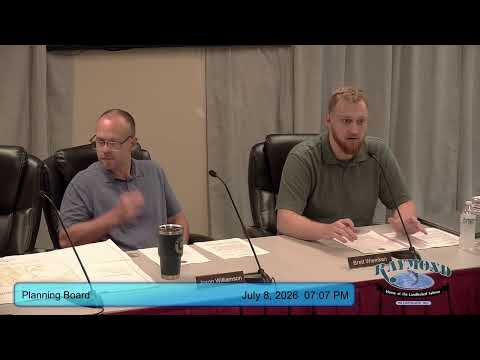
At a workshop July 8 the Raymond Planning Board agreed to revisit the town’s short‑term rental ordinance and to begin a prioritized review of ordinances affected by recent state housing mandates.
Chair opened discussion by noting the short‑term rental ordinance had failed at referendum but drew substantial support; the board debated whether to resubmit the same measure or to break it into narrower actions. “Maybe look at only taking some of the cabins … even the no vote was for data collection,” the chair said, urging the board to consider separating noise and data‑collection items from the broader ordinance.
Board member Jackie Sawyer suggested starting with a registration and data‑collection approach rather than a more punitive ordinance. Staff and members said a scaled approach (initial registration, followed by enforcement measures if needed) could improve public acceptance. Jason (staff) and Brett (staff) recommended engaging GPCOG and other regional resources for software and legal review; GPCOG representatives reportedly offered a package to register units and assist enforcement and fee collection.
The board also discussed implications of LD 1829 and state subsurface rules for ADUs and minimum lot sizes. Jason said recent state changes will force multiple local ordinance updates — from definitions of dwelling units and subdivision standards to shoreland zone uses and manufactured‑home rules — and suggested the board commission a zoning/ordinance audit to identify conflicts and prioritize changes.
The board set a target timeline for ordinance work to meet the town’s July 1, 2027 compliance deadline: aim for comprehensive draft language by January so legal review and required state/MOCA reviews can occur before warrant season in April. Members proposed using available grant funds to hire technical assistance and to count volunteer time for grant reimbursement.
Next steps: staff will compile a list of ordinances affected by LD 1829 and related mandates, reach out to GPCOG and legal services, and return with a prioritized list and draft language for the next meeting; the implementation committee for the comprehensive plan was urged to reconvene to support ordinance alignment.