Get Full Government Meeting Transcripts, Videos, & Alerts Forever!
Get email alerts on the GMH Budget topic
No spam. Unsubscribe anytime.
Senators press OFB over GMH shortfalls and $20M bookkeeping discrepancy
Summary
Senators questioned Guam Memorial Hospital’s FY27 funding and asked OFB to clarify whether GMH undercollected projected revenues and why a $20 million FY26 appropriation tied to excess revenue isn’t shown as a liability in CER reports. Lawmakers signaled amendments to bridge a reported $21 million shortfall.
Senators pressed the Office of Fiscal Management on the funding picture for Guam Memorial Hospital (GMH), asking whether the hospital is undercollecting revenue and whether the substitute budget covers an anticipated shortfall.
Senator Perez asked why GMH’s initial budget submission described a $36 million gap while the substitute bill shows a $36 million general‑fund appropriation and separate lines for other amounts. He told OFB that GMH projected $128 million in revenue for the coming fiscal year and asked whether GMH had failed to collect expected receipts this year, which would compound the need for supplemental appropriation.
Steve Guerrero, an OFB official who answered senators’ questions, said he did not have GMH’s precise collection figures on hand and noted the agency requested about a $39 million increase over FY26. Guerrero said OFB had increased the FY26 operations figure by $5 million in its working numbers for FY27.
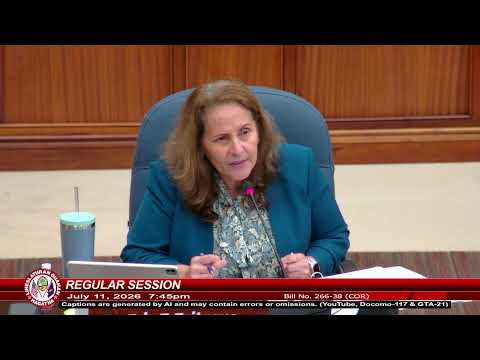
Senator Montanani reviewed figures she had received and relayed conversations with GMH leadership. She said GMH reports a $21 million shortfall and indicated she plans to offer an amendment to provide bridge funding while the hospital’s revenue‑cycle improvements and other projects take effect. "I'm going to fight for GMH because they have proven to us," Montanani said, arguing that near‑term support is needed because savings from ongoing projects are not expected until FY28.
Separately, senators questioned why $20 million appropriated in FY26 from ‘‘excess revenues’’ did not appear as a liability in the CER/CRER financial reports. Senator Talotaragu noted the June CER report and asked whether that $20 million was being accounted for as a liability. The chair and OFB explained that the appropriation language ties the payment to audited financial results; under a strict reading, BBMR/OFB advised the amount would not be booked as a liability until audit completion. The chair said that is why staff recommended amendments to change the triggering language so the appropriation could be realized earlier.
Guerrero summarized an ‘‘excess revenue’’ figure discussed by BBMR — roughly $88 million — and said that after subtracting known obligations (special‑fund shortfalls and other appropriations) the net available could be about $39–40 million by fiscal‑year end. He cautioned that timing and the legal language of appropriations affect whether amounts are shown as liabilities in the CER report.
No formal vote or final action occurred during the exchange. Senators asked OFB to produce project‑level revenue and collection data from GMH and said they would pursue amendments during the miscellaneous provisions to ensure bridge funding is available if needed.