Get Full Government Meeting Transcripts, Videos, & Alerts Forever!
Get email alerts on the Franco American History topic
No spam. Unsubscribe anytime.
Historian traces four centuries of Franco‑American life in Champlain Valley
Summary
At a Samuel D. Champlain History Center lecture, historian Dr. Patrick Desrois outlined four centuries of French Canadian migration, parish formation and community organization in the Champlain Valley and answered audience questions about border crossings and local demographics.
Dr. Patrick Desrois, a historian and director of the Acadian Archives at the University of Maine, told an audience in Champlain that French‑speaking migrants have shaped the Champlain Valley for more than 200 years.
“This is the making of French life in Flint County,” Desrois said, summarizing his talk on early settlement, mid‑19th‑century migration from Quebec and the institutions—parishes, newspapers and political assemblies—that tied Franco‑American communities together.
Desrois framed the lecture as a lateral correction to histories that focus on New England mill towns, arguing New York State hosted sizable and enduring Franco‑American populations. He cited census sampling showing Plattsburgh, Champlain and nearby towns had large proportions of Canadian‑born residents in the 19th century and noted that, by 1910, roughly 2,300 Clinton County residents were Canadian‑born with nearly 3,000 more born in the U.S. to two Canadian parents.
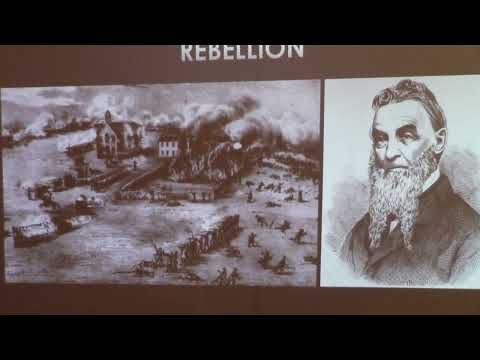
The historian described two migration streams: early settlers and political refugees who fled the Lower Canada rebellions of 1837–38. Those exiles, he said, helped seed political organization and cultural observances on U.S. soil—the lecture highlighted an 1839 Saint‑Jean‑Baptiste celebration in Swanton as an early example.
Religious organization also shaped community life, Desrois said, recounting missionary circuits run from Quebec, the arrival of Oblate priests in the 1840s–50s and the founding of permanent parishes such as St. Peter’s in Plattsburgh. He warned that surviving parish and missionary records are uneven: some baptisms and marriages survive, he said, but burial records are often missing, which complicates genealogical tracing.
Desrois traced the role of French‑language newspapers and political assemblies in the mid‑19th century. He described La Nationale, a Plattsburgh publication that later moved to Lowell and became part of a Franco‑American newspaper network that sometimes relied on partisan funding.
The presentation closed with practical context: Desrois discussed how nineteenth‑century crossings across Lake Champlain were often informal until the late 19th and early 20th centuries, when checkpoints expanded. During the Q&A, a participant who identified himself as a U.S. Customs official said small crossings were formalized during Prohibition and noted, of one 1932 border station, that “the well is in the basement because of Prohibition.”
Local genealogy vendor Sebastian of genealogyquebec.com offered a limited discount to audience members and outlined subscription options for people seeking Quebec records. The program ended with announcements from the hosting institution and an invitation to a subsequent event about canal boats.
Why this matters: Desrois’s talk underscores that Franco‑American history in the Champlain Valley developed its own institutions and demographics distinct from the New England mill‑town narrative; the historical presence remains visible in local parishes, cemeteries and place names and informs contemporary community‑history work.
The lecture concluded with a brief Q&A; no formal actions or policy decisions were taken. The Samuel D. Champlain History Center announced its next America 250 series presentation for the following Wednesday and offered refreshments.