Get Full Government Meeting Transcripts, Videos, & Alerts Forever!
Get email alerts on the Special Education topic
No spam. Unsubscribe anytime.
Community urges Granite School District to preserve special-education staffing amid proposed cuts
Summary
Parents, educators and community members urged the Granite School District board to halt proposed reductions to special-education staff, citing legal obligations under IDEA/FAPE, potential compensatory costs and a petition now signed by hundreds across the district.
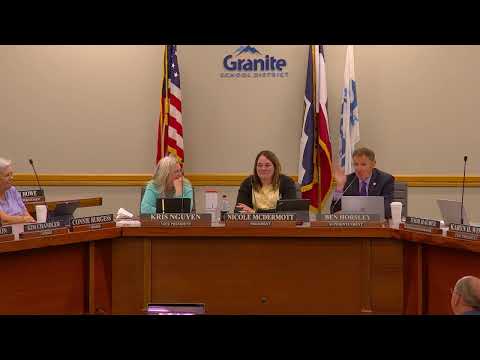
Hundreds of parents, educators and advocates told the Granite School District Board of Education on July 7 that proposed reductions to special-education staffing risk harming students and could expose the district to legal and fiscal liabilities.
At the start of patron participation, one commenter identified as Danielle Hausman told the board: "This isn't a plan. It's cuts without analysis, and our children deserve better." She argued the district has not demonstrated how it will meet students' Individualized Education Program (IEP) minutes after proposed staff reductions and warned that a teacher split between two schools "could easily carry a caseload of 44 students".
Physician and parent Ellie Moreno said she objected to reductions "in the special education services," describing how inadequate supports at a prior private school led to a child's expulsion and arguing that public schools should remain a reliable pathway for diagnosis and intervention.
Philip Dimock presented a rapidly growing petition opposing the cuts, saying organizers collected over 600 signatures within days and that "Currently, 824, from 24 primary schools and 16 secondary schools across the district." He urged the board to audit IEP service minutes before cutting staff and to consider using district reserves rather than reducing services.
Multiple commenters, including parents and educators, told the board that removing paraprofessionals and specialist positions would increase safety risks, reduce instructional time, and drive up long-term costs through compensatory education and potential due-process cases. Katie Fortenberry summarized nearly 900 petition comments into themes including educator strain, the essential nature of services, and a call for transparency in how special-education funding is allocated.
Breezy Davis, president of the Granite Education Support Professionals Association, praised award recipients among ESPs and urged collaborative labor relations as the district considers personnel decisions.
In response to public comment, district representative Ben Worsley thanked speakers and said the administration would continue to address concerns "through the administrative process," offering assistant superintendent Leslie Bell to facilitate follow-up meetings and noting staff (including Doug Larson) were reviewing proposals from immigrant-advocacy groups.
The board did not take immediate action on the special-education staffing plan during the meeting. Commenters asked for an audit of current IEPs, clarity on the district's calculation that led to the shortfall (speakers said an administrative undercount of roughly 1,000 students triggered federal funding gaps), and consideration of reserve funds to maintain services. The petitioners requested an explanation of how the undercount occurred and steps to prevent future occurrences.
Next steps: the district said it will continue administrative follow-up and offered meeting facilitation; petition organizers requested board action before the 2026–27 school year begins.