Get Full Government Meeting Transcripts, Videos, & Alerts Forever!
Get email alerts on the Budget topic
No spam. Unsubscribe anytime.
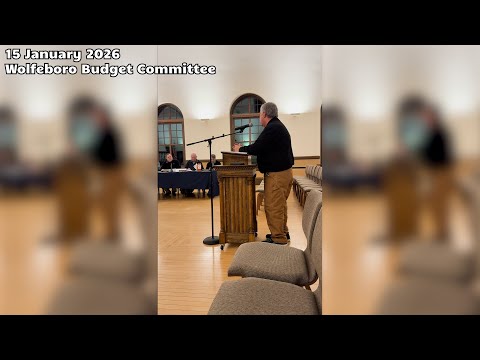
Presenter outlines 6.72% proposed budget increase; committee records 4‑4‑2 on recommendation motion
Summary
At a meeting of the Wolfeboro Budget Committee, a presenter summarized a proposed FY2026 budget of $35,913,502 (a 6.72% increase), detailed drivers including wages and debt service, and members debated enterprise‑fund accounting and presentation format; a motion on recommendation recorded a 4‑4‑2 tally and did not carry.
A presenter for the Wolfeboro Budget Committee outlined a proposed FY2026 budget of $35,913,502 — a 6.72% increase from the prior year — and described the fund mix and series drivers that pushed the proposal higher.
The presenter said the general fund totaled $20,409,255 (about 57% of the proposed budget) and that the budget’s Series 100 (wages) shows $7,383,000, an increase the presenter described as driven in part by additional ambulance staffing and contract increases. He summarized debt service and other series impacts and said the committee began with a higher departmental submission but reduced it to the current proposal through cuts and adjustments.
Why it matters: committee members and residents pressed for clearer public presentation because many voters will see the report only once before a vote. A resident told the committee it is “unacceptable” that local taxes have risen sharply, saying the town has been on a roughly 10% annual trajectory for four years and that enterprise fund entries sometimes exceed historical revenue; the resident said many constituents on fixed incomes face hardship and asked why enterprise funds are included in the operating figures rather than treated as self‑sustaining.
Committee discussion focused on three linked issues: the underlying cost drivers (wages, health insurance and contract costs), how enterprise funds are shown in the gross appropriation, and whether the presenter should reformat the materials by department for clearer public consumption. Several members asked staff to provide more graphical, back‑up materials and historical context for enterprise transfers, citing the ice‑rink account as an example (budgeted at about $69,000 vs. roughly $52,000 in recent revenue, with projected increases because the rink is open longer).
Members also debated procedure. The committee’s attorney advised that the Budget Committee must take a vote on a motion to "not recommend" and that the committee should use explicit motion language to reflect its intent. A recorded tally on the motion was reported as 4 yes, 4 no, and 2 abstentions; members discussed how abstentions affect the committee’s recommendation and whether the result requires the minutes to state "not recommended." The attorney advised taking a clear vote and, if a motion does not carry, to include explicit language as appropriate.
What was decided: members agreed to proceed with the presenter’s overview and to split the material by department for a more detailed departmental review at a follow‑up meeting (scheduled for the 22nd), but the motion regarding formal recommendation did not carry after the 4‑4‑2 tally. No final recommendation replacing or reopening the vote was recorded in the transcript.
Quotes that capture the discussion include the resident’s comment that "we have been on a trajectory over the past 4 years of a 10% increase annually in our ending tax rate," and the presenter’s summary that the proposal is for "$35,913,502, or an increase of 6.72%."
Next steps: the committee scheduled departmental reviews of the presenter’s materials for more detailed line‑by‑line consideration and asked staff to provide clearer, graphical backup and historical figures for enterprise funds before the next meeting.