Get Full Government Meeting Transcripts, Videos, & Alerts Forever!
Get email alerts on the Justice Center topic
No spam. Unsubscribe anytime.
Monroe County commissioners press for quick site selection and single-story design for proposed Justice Center
Summary
At their July 9 meeting, the Monroe County Board of Commissioners reviewed a site matrix for a proposed Justice Center and emphasized needing roughly 25 acres for co-location and a single-level jail to reduce long-term costs and security risks; the board plans further studies and public engagement.
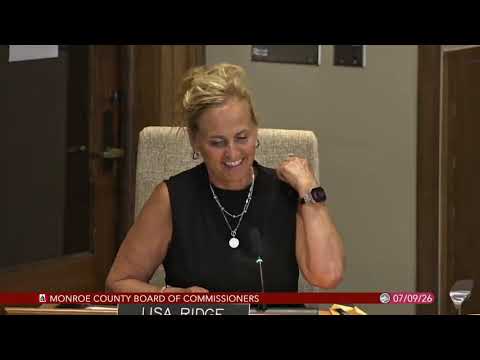
The Monroe County Board of Commissioners spent the bulk of its July 9 meeting reviewing a site-selection matrix for a proposed Justice Center and stressing two priorities: speed and sufficient land to co-locate justice functions.
"We need to find at least 25 acres," Commissioner Madera said during the discussion, describing that figure as a minimum to accommodate a jail, prosecutor, public defender, courts and the clerk's office. Commissioners said acting quickly also helps limit construction inflation and legal exposure.
County leaders and consultants presented a public-facing chart and an interactive map showing candidate parcels and scored them on factors such as build time, access, zoning constraints, sewer access, slope and cost. The board indicated it will post the matrix and a clickable site map to the Justice Center project website so residents can review the same materials shown at the meeting.
Commissioner Madera argued for a single-floor jail design, citing peer-reviewed research that the county said links single-level, podular facilities with fewer violent incidents and better staff/inmate outcomes. "A single floor jail facility is both empirically valid, evidence-based," Madera said. "It enhances inmate and staff well-being. It's more secure for jail staff and inmates."
The commissioners discussed practical site constraints: city parcels add roughly a year to the approval timeline because of city planning and council processes, while large county parcels sometimes have slope, floodway or utility obstacles that limit usable acreage. Chair noted that some parcels that appear large on paper have substantial unusable features — "most of that is going to be unusable," the Chair said — and said geotechnical studies and design-stage documents will still be needed for any candidate site.
Board members also addressed the role of a nonbinding collaborative Justice Working Group that is reviewing sites and public concerns. Commissioner Madera described the group as educational and useful for surfacing questions and correcting misinformation but emphasized that its recommendations do not replace the board's statutory responsibilities. "A nonbinding group can still play an educational function," Madera said, "but these don't decide the issue for us."
The board agreed it will continue to prioritize time and co-location in evaluating options and to keep the public informed through the project's website. Commissioners said the working group will meet again before issuing a recommendation and that the board expects further, site-specific geotechnical and circulation studies before any formal selection or appropriation.
Next steps: commissioners plan additional study work and public updates; a work session was scheduled later the same morning to hear from the sheriff's office and planning staff.