Get Full Government Meeting Transcripts, Videos, & Alerts Forever!
Get email alerts on the Water Infrastructure topic
No spam. Unsubscribe anytime.
Regional water project update: commissioners hear plan to combine donated water rights, $130M regional pool and pilot construction
Summary
County commissioners heard a detailed update on the Grant/Grama County Regional Water Project, including past investments, Freeport McMoran donations of water rights, a $130 million regional funding pot and next steps to pursue New Mexico Unit and Water Trust Board construction dollars. No final action was taken; staff will apply for pilot construction funding.
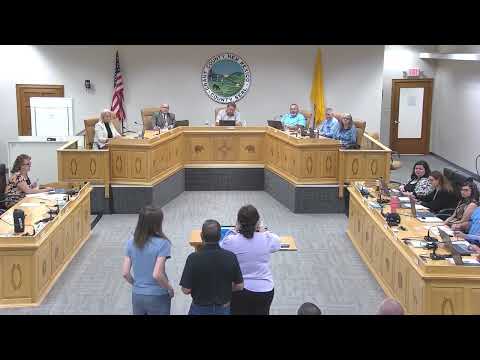
Commissioners on July 7 heard a multi-part update on the Grant County Regional Water Project aimed at delivering a reliable supplemental water supply to several local associations and towns.
Priscilla Lucero, representing the Southwest New Mexico Council of Governments, and Alex Brown, a retired city manager who volunteers on the project, told the board the effort is intended as a pumping and long-distance transmission system that would deliver water to local systems without subsuming those utilities. "What it is is basically a pumping and transmission system to just transport water and deliver it to a single point at each one of our water systems," Lucero said.
Why it matters: presenters said the project would expand capacity for Hurley, Santa Clara, Hanover and other special districts, enabling housing and economic development that local leaders say cannot proceed without reliable water. The commission learned that Freeport McMoran has donated water rights and a well, and that prior work and donations plus recent investments total in the tens of millions.
Key details: Alex Brown said the project has already received about $19 million in investments and that Freeport has donated roughly 200 acre-feet (and additional rights) at multiple sites. Lucero said the larger four-county region that this multi-jurisdictional effort sits inside currently has about $130,000,000 set aside for regional water efforts; the project team is pursuing pilot construction dollars and a New Mexico Unit grant application due in August (Lucero said that cycle would seek approximately $14 million). Lucero also said the project is 90% designed for the Hanover–Santa Clara phase and that remaining phases require additional funding and a roughly $1 million design-completion gap.
Funding and process questions: several commissioners pressed presenters on why, if $130 million exists for the region, local systems must still seek loans or match funds. Lucero explained the funds are being managed across multiple agencies and boards — the New Mexico Finance Authority, the Water Trust Board, and the Interstate Stream Commission — and that the initial construction efforts are being treated as a pilot to shape policy and protect the regional pot for long-term use. "We did the pilot to ensure that the policies with the planning piece were aligning with what we're wanting to do," Lucero said, adding that the pilot structure responds to statutory and agency requirements and greater accountability on the ISC side.
Private partner role: Laura Phelps of Freeport McMoran described the company’s early involvement and its water-right donations. "We realized really quickly, if there isn't water and there isn't a wastewater treatment plant that's functioning, there won't be economic development in the mining district, and that's really where this started for us," Phelps said. She said Freeport has committed up to $1,000,000 in matching funds for related wastewater work and will donate water rights to help Hurley and other communities own their water supply.
Remaining steps: presenters said the near-term priorities are finishing remaining design work, applying for New Mexico Unit construction dollars in the current cycle, and sequencing construction to leverage the regional funding while avoiding exhausting the pot immediately. No formal board vote on policy or funding occurred in the work session; presenters asked the commission to continue its support and indicated staff will pursue the listed grant cycles.
Ending: The board did not take formal action on the project at the work session; staff and the water commission will continue to pursue grant and pilot-construction funding and report back as applications and procurement progress.