Get Full Government Meeting Transcripts, Videos, & Alerts Forever!
Get email alerts on the Land Use Development topic
No spam. Unsubscribe anytime.
Cecil Township supervisors continue Cool Valley conditional-use hearing after residents raise traffic, buffer and stormwater concerns
Summary
Developers presented a 216-acre illustrative plan for retail, ~225 apartments and ~70 townhomes; residents and supervisors pressed for clearer traffic phasing, a usable second exit, verification of a 50-foot undisturbed buffer and DEP/PennDOT approvals. The hearing was continued to Aug. 3 at 6 p.m.
Cecil Township supervisors on July 7 continued a conditional-use hearing for the 216-acre Cool Valley Development after residents and board members raised unresolved questions about traffic, access and environmental protections.
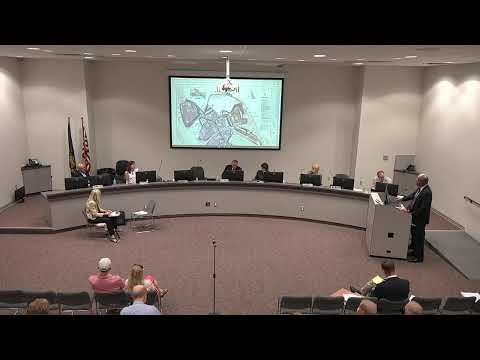
John Haines, representing Cool Valley Development Company LLC, presented the illustrative master plan, saying the site along I‑79 near the Southpointe interchange would include retail pads, an apartment complex and townhomes. "Cool Valley Development is, I can say is a long time coming, and we're pleased to present ... and to seek your approval," Haines told the board. Project engineers said the site design proposes three major intersection improvements and internal roads to connect pads labeled A through I.
Engineer Keith Vasas, GAI Engineering’s director, walked the board through the plan’s numbers: "The site is 216 acres," he said, with about 36 acres to remain undisturbed, roughly 74 acres identified for shops, about 60 acres of impervious pad area, 9 acres of roads and 12 acres of basins. Vasas described a strategy to move from regional stormwater basins to basins tied to individual pads and to rely more on infiltration where possible. He said the project has will‑serve letters from multiple sewer authorities and that DEP (NPDES) and PennDOT permits remain part of the next steps.
Despite the technical detail, several supervisors and many residents said the presentation left key implementation questions unanswered. Supervisor Darlene Barney and others pressed the applicant on whether off‑site intersection work would be completed before occupancy and who would be responsible if traffic problems later emerged. Vasas responded that some buildout can proceed in phases tied to completed improvements and that PennDOT reviews and approvals limit the square footage that may be built before certain intersections are improved.
Residents from Maple Ridge and nearby neighborhoods urged stronger protections and clearer access. Michelle Turbanic, president of the Maple Ridge HOA, said the proposed 50‑foot undisturbed buffer was not enough and that the community needs a reliable second exit. "50 feet just isn't enough," she said, adding that Maple Ridge residents fear erosion of the buffer and long‑term maintenance impacts on Morganza Road.
Other public commenters said trees near the boundary had already been removed and questioned whether the developer’s assurances matched on‑the‑ground conditions. Ray Mazzoni of Maple Ridge said recent clearing made the claimed buffer hard to reconcile with what neighbors see; Vasas and Haines said the developer measured and left a 50‑foot undisturbed area and invited board inspection. The engineer also said hydraulic and hydrology studies and DEP review will guide any stream or culvert work.
Residents raised additional concerns about: school capacity from new households (applicant said impacts were not quantified at the master‑plan stage); whether private interior roads would be permanently private (applicant said the intention is HOA maintenance; board members said they would not approve plans that later shift maintenance costs to township taxpayers); and the location and timing of queuing at gated entrances for the proposed townhomes and apartments.
Board members repeatedly said they would expect detailed land‑development submissions, traffic phasing tied to PennDOT capacity decisions, financial security and a development agreement before any binding approvals. Multiple supervisors said they wanted conditions added so that buildout cannot exceed limits set by PennDOT traffic determinations.
After two hours of presentation and public testimony, the board voted to continue the hearing to Aug. 3 at 6 p.m. Supervisor Guizio made the motion; it was seconded and the board indicated unanimous assent with an "aye" vote. The continuance gives applicants time to provide requested clarifications — including verified buffer measurements, more detailed traffic‑phasing information and stormwater/hydraulic reports — and allows supervisors to seek PennDOT or county input on sequencing of intersection work.
The hearing is a master‑plan, illustrative approval only; the board and staff emphasized that every individual pad, townhouse parcel and apartment complex will require subsequent land‑development submissions, financial securities and permitting before construction can proceed.