Get Full Government Meeting Transcripts, Videos, & Alerts Forever!
Get email alerts on the Housing Policy topic
No spam. Unsubscribe anytime.
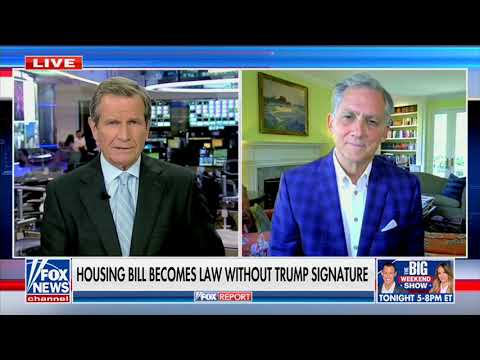
Road to Housing Act becomes law without White House signature; authors say it will boost supply and cut costs
Summary
The Road to Housing Act was enacted without President Trump’s signature, a rare move. House Financial Services Chairman French Hill said the law will increase housing supply, lower construction costs and curb institutional purchases of single-family homes; HUD Secretary Scott Turner attributed some price rises to migration.
A major housing bill known as the Road to Housing Act became law without President Trump’s signature, a rare occurrence that anchors noted was last seen in 1975. House Financial Services Chairman French Hill, one of the bill’s chief architects, said the measure is designed to expand housing supply and lower the cost of building homes.
"I do think he should have signed the bill because at the margin, it will lower the cost of housing," Hill said in an interview, adding the law "will increase the supply of housing, [and] make housing more accessible." He also said the law contains a component the president requested to limit institutional investors from buying single-family homes that could compete with "moms and dads who are trying to buy their first house."
The discussion included a brief clip of U.S. Department of Housing and Urban Development Secretary Scott Turner, who said, in part, "When we first came in, with President Trump, we had open borders. We had tens of millions illegals in our country. That made housing prices go up about 30%. Rental prices go up 20%." Hill said migration "could be a factor" but emphasized structural supply shortages and inflation as important drivers.
Hill traced the shortage of new housing to the aftermath of the 2008–09 global financial crisis and cited pandemic-era inflation as another contributor. "We've had a shortage of housing constructed in this country since the end of the global financial crisis, 2008 to 2009, despite low interest rates," he said, and added that inflation under President Biden reached near 40-year highs and raised construction costs.
Hill said the bill seeks to address costs by cutting regulatory barriers—he estimated that regulatory requirements account for roughly 20% to 30% of single-family housing costs—and by encouraging cities and counties to adopt more flexible zoning and opportunity-zone incentives. He also said the law removes some environmental review requirements for certain HUD program funds to speed use of federal dollars for housing.
Anchor data cited during the segment noted starter-home price counts rising from about 80 U.S. cities with starter-home prices above $1,000,000 in February 2020 to 242 in April 2026. Hill said the law aims to help lower the median age of first-time homebuyers, which he said has risen to about 40 and should return toward a more historic level near 30.
The segment ended without further formal debate; Hill thanked the host before the program moved to unrelated political coverage.