Get Full Government Meeting Transcripts, Videos, & Alerts Forever!
Get email alerts on the Goal Monitoring topic
No spam. Unsubscribe anytime.
Providence School Board workshop focuses on goal monitoring, calendar and superintendent oversight
Summary
At a Feb. 9 workshop, the Providence School Board and trainers from the Council of the Great City Schools walked members through a monitoring calendar and report framework designed to tie district goals to data, budgets and superintendent evaluation. The superintendent’s office was assigned a draft calendar as a next step.
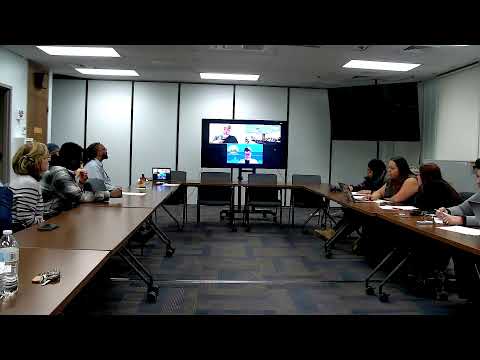
Tamriel Stevens, president of the Providence School Board and Committees, opened a Feb. 9 workshop with a session led by trainers from the Council of the Great City Schools to introduce a board-owned approach to goal monitoring.
The training stressed that monitoring is a continuous-improvement process: the board adopts community-derived goals, the superintendent defines interim outputs and initiatives, and the board uses periodic data to judge whether initiatives are working. “This is your opportunity to ask all the questions you have, dig into that, and then you’ll be able to actually practice,” a presenter told board members during the session.
Why it matters: presenters and members said disciplined monitoring can prevent “initiative fatigue” — when frequent changes make it impossible to tell what works — and create clearer accountability for student outcomes. Trainers recommended that each board goal be monitored at least four times a year and that guardrails be monitored at least once annually so the board gets both frequent status checks and room to pivot when needed.
Key elements discussed included establishing clear targets and baselines, presenting predictive or interim metrics, explaining the strategies (inputs and initiatives) intended to move outcomes, and including a concise recommended next step in every monitoring report. Presenters said monitoring reports should include trend windows (for example, three-year trends or defined reporting cycles) and an explicit statement of whether staff interpretation agrees with the raw data.
The session also connected monitoring to budgeting and resource decisions. A trainer walked through a hypothetical budget slide showing planned disinvestments and redeployments, saying that shifting money from lower-impact work could free significant resources for priority initiatives — “that’s gonna net us almost $20,000,000,” the presenter said as an example of the scale of potential reallocation.
Board members practiced crafting effective monitoring questions using a SMART framework. In an exercise converting an ineffective, opinion-driven prompt into a monitoring question, Angel Lubin, vice president of the school board, offered a model: “I hear that we’re off track on goal two. What specific strategies did you enact over the last three months, and what did you learn?” The coaches praised the revision as focused on strategy, evidence and lessons learned.
On superintendent oversight, trainers explained that accepting or returning monitoring reports is a form of rolling, formative evaluation: repeatedly accepting reports without reservation constrains end-of-year evaluations, while returning reports or asking for clarifications signals earlier concerns to be addressed. Trainers recommended using a consistent status convention (for example, green/yellow/red) and asked boards to treat early returns as calibration rather than immediate punitive action.
Next steps: the superintendent’s office was assigned to prepare a draft monitoring calendar that maps interim goals and guardrails to monitoring windows and accounts for staff analysis time; the board will review that draft and add board-led trainings, community sessions and self-evaluations. Trainers offered additional templates for superintendent evaluations and policy-monitoring guidance to be shared with the board.
The workshop closed after members agreed to have district staff produce the draft calendar and to schedule follow-up support from the Council of the Great City Schools.