Get Full Government Meeting Transcripts, Videos, & Alerts Forever!
Get email alerts on the Parks And Recreation topic
No spam. Unsubscribe anytime.
Panama City workshop weighs selling or repurposing underused parks, seeks clearer cost and legal analysis
Summary
City staff and the Parks and Recreation Advisory Committee recommended considering divestment, partial transfers and public‑private partnerships for several underused parks while proposing launch fees and volunteer programs to offset maintenance; commissioners asked staff for detailed cost breakdowns and a parcel‑by‑parcel legal summary.
City Manager Jonathan Hayes convened a Panama City workshop to review a year‑long Parks and Recreation Advisory Committee (PRAC) report that recommends realigning responsibilities for several parks, pursuing public‑private partnerships and testing new revenue tools such as launch fees and sponsorships.
Keith Myrell, a Parks and Recreation staff member who presented the committee’s findings, said the committee considered the city’s inventory (53 total sites: 38 parks, seven community recreation centers, three cemeteries, two marinas and three special facilities) and compared local acreage and amenities to National Recreation and Park Association benchmarks. Myrell said the committee recommended expanding volunteer programs (the “Doctor Park” and Adopt‑a‑Park initiatives), exploring sponsorships at roughly 11 parks, considering divestment or realignment of about six parks and pursuing one targeted public‑private partnership.
The report singled out several properties for specific treatment. For Lanny Rowe Park staff recommended retaining parkland for recreation while shifting stormwater maintenance to Public Works. Ken Hammonds Park was described as a watershed property in need of repairs (broken footbridges, resurfacing) with a committee option to transfer the east portion for housing and the west portion to Public Works for drainage functions. Whittington Park sits in a Florida Department of Transportation right‑of‑way; the committee recommended returning it to FDOT to reduce the city’s maintenance burden, but commissioners and staff cautioned that FDOT may be unlikely to accept ownership given recent grant‑funded work.
“Main Street’s kayak launch is a hazardous location for kayak access,” Myrell told the commission, recommending divestment or sale to adjacent commercial operators to limit the city’s liability. Commissioners and staff said the site is overgrown and not an obvious formal launch point, heightening concerns about waterborne debris and public safety.
Carl Grama Park generated particular attention: Myrell said annual dredging costs run “about $60,000 to $100,000,” and mowing costs were quoted at roughly $650 a week. The committee suggested reverting the park to state or county control, or — if retained by the city — instituting boat‑ramp or beach access fees to help cover maintenance of the waterfront facilities.
Commissioners pressed staff on the budget numbers and what they did and did not include. Myrell said the maintenance figures presented to the commission reflect a “minimum” level of landscape maintenance and are based on internal labor hours and fully loaded employee costs (hourly wages plus benefits). He and other staff clarified that the spreadsheet did not include dredging, specialized equipment, materials or some contracted services; commissioners requested a fuller, itemized accounting that includes materials, contract labor and other operating costs.
Legal counsel told the commission that deed restrictions and grant terms are the principal limits on divestment. “A deed restriction is just a restriction, not an absolute,” counsel said, explaining that in some cases a restriction can be removed or negotiated but that state grants may require repayment of funds if park uses change.
Several commissioners urged a cautious, staged approach: identify low‑controversy parcels first (examples discussed included the Main Street kayak property and certain neighborhood parcels such as Cove Lane), test launch fees and vendor agreements, and explore whether high‑cost waterfront parks might qualify for state park designation. Commissioners also emphasized keeping any proceeds or new funding within the affected neighborhoods and avoiding actions that would erode neighborhood access before alternatives exist.
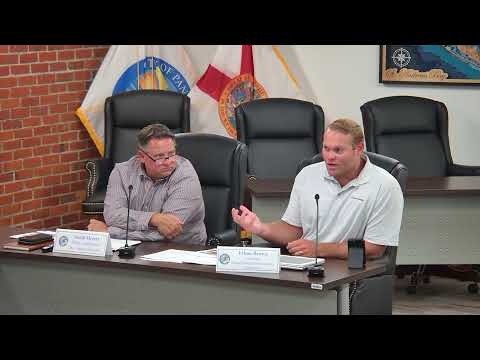
Ethan Brown, identified as PRAC chair, listed the committee membership and said the group sought to balance operational realities with neighborhood needs. City Manager Hayes said staff will return with more detailed cost breakdowns and a parcel‑by‑parcel legal summary of restrictions for discussion at the commission’s August meeting.
The workshop ended with the mayor adjourning the meeting; no formal vote or motion was recorded at the session.