Get Full Government Meeting Transcripts, Videos, & Alerts Forever!
Get email alerts on the Land Use Growth Management topic
No spam. Unsubscribe anytime.
Weare subcommittee weighs permit cap, zoning data after survey finds opposition to clustered subdivisions
Summary
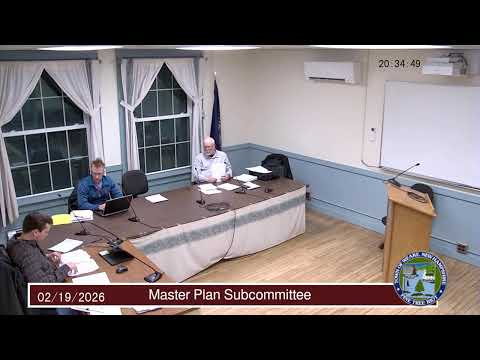
At a Feb. 19 Master Plan subcommittee meeting, members debated an annual cap on new dwelling-unit building permits, recommended compiling historic building-permit and variance data, and discussed using that evidence to guide zoning amendments to preserve Weare’s rural character.
The Weare Master Plan subcommittee on Feb. 19 discussed whether to impose an annual cap on residential building permits and to compile historic data on permits and zoning variances to guide future zoning changes.
The discussion followed survey results that, according to one committee member, included a proposal “to put a cap on the number of living unit building permits allowed each year.” Committee members argued that data on actual permits and the variances that enabled them would show whether zoning on the books matches what happens in practice and whether exceptions have eroded rural character.
Why it matters: committee members said relying on documented permit and variance trends would provide a firmer basis for any policy that limits new units or modifies zoning, rather than relying on ad hoc variance decisions. Chair framed the problem as a mismatch between zoning language and outcomes and urged an evidence-based approach.
Committee member S3 said the cap should not be an automatic formula: “review the cap as part of when the master plan is updated,” suggesting periodic review tied to the master-plan cycle rather than an automatic adjustment every five or 10 years. The group agreed the Planning Board should compile historic annual counts of building permits and variances and that any agreed-upon cap should be revisited with subsequent master plans.
Members also discussed how frequent variances can create the perception that a community’s rural character is slipping. S3 urged the committee to categorize variances and exemptions to determine whether certain exceptions are routinely granted, and, if so, to propose zoning amendments for voters to consider rather than relying on repeated variances.
On economic-policy tools, committee members flagged impact fees as a technical mechanism that would require a fee schedule based on costs developers should bear, and recommended the Planning Board or town staff research how other towns implement impact fees.
The committee did not adopt formal policy at the meeting. Next steps included asking the Planning Board or staff to compile historical permit and variance records and drafting a proposed objective that the Planning Board would use to recommend an annual cap revisited with each master-plan update. The meeting adjourned by unanimous voice vote at 08:39.