Get Full Government Meeting Transcripts, Videos, & Alerts Forever!
Get email alerts on the Historic Preservation topic
No spam. Unsubscribe anytime.
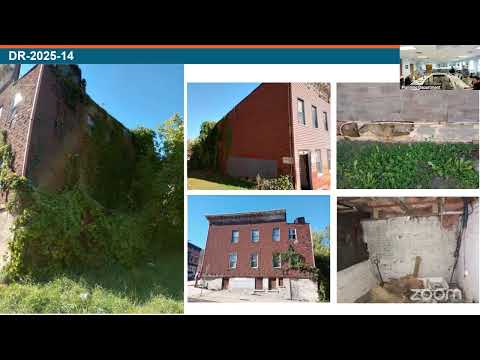
Historic Resources Commission hears land bank plan to salvage 45 2nd Avenue cornice
Summary
A land bank representative told Albany City's Historic Resources Commission that the wooden cornice at 45 2nd Avenue is deteriorated and likely must be removed in sections; commissioners pressed for careful salvage, questioned donation/storage plans, and asked for a follow-up report before demolition.
The Historic Resources Commission met July 13 and heard a presentation from a land-bank representative about efforts to document and salvage the historic cornice at 45 2nd Avenue in the Brosebeckville District. John Myers, chair of the commission, opened the meeting and noted the 29 Fair South Ferry Street application had been withdrawn from tonight’s agenda.
Jason Chicoine, a representative for the land bank, told the commission he had met with Historic Albany’s warehouse manager and relayed that the cornice — a wooden architectural element that runs across the front and around the corner — is deteriorated. Chicoine said Historic Albany recommended removing the cornice in roughly four-foot, corbel-to-corbel sections and that "any anything that is salvageable would be donated to Store Colony" (Historic Albany was the entity referenced in the presentation). Chicoine said a demolition contractor under the land bank’s existing contract has supplied a proposal that includes both demolition and the proposed salvage work.
That recommendation left commissioners with concerns about whether the approach met the commission’s intent to preserve architecturally useful material. One commissioner said the proposed method — cutting the cornice into multiple small pieces — "doesn't feel like it met the intent of what we were trying to achieve," noting that breaking the element apart could make later reassembly on a building impractical. Another commissioner asked whether salvaged pieces would be returned to the same building in some reassembly or instead be repurposed for decorative objects.
Commissioners pressed the land bank on storage and ownership questions. A commissioner who joined the meeting late cited a prior Wellington cornice case and asked whether the commission could require donated cornices to be held in trust or otherwise restricted; staff replied that the language of the prior motion required the applicant to "determine the feasibility of salvaging and storage of the historic cornice" and submit that determination to the commission prior to demolition, but did not prescribe enforceable restrictions on how a third party would use donated material.
Commissioners and staff agreed on two practical points: first, Historic Albany indicated it could store salvaged material if the land bank arranged that; second, the salvageability and ultimate condition of the cornice can only be determined when crews begin work. Chicoine said the salvage crew would plan to spend roughly a day on salvaging (possibly two, depending on conditions) using a lift, and that the contractor could provide close-up photos, component dimensions, and a catalog of parts to aid any future reconstruction.
Commissioners sought a follow-up report. Staff reiterated that the redevelopment proposal for the site will return to the Historic Resources Commission as part of any reconstruction review, giving the commission another chance to discuss how salvaged elements might be reused. Commissioners asked the land bank to provide a written summary of salvage work and a second, on-the-ground report describing what was actually recoverable once removal began.
No vote was taken during the presentation; the commission’s prior motion approving demolition with conditions (including the documentation and salvage-feasibility requirement) had already passed at an earlier meeting. The commission adjourned after a brief discussion of an unrelated mural item that was withdrawn from the agenda.
What happens next: the land bank will proceed with salvage planning and is expected to report back to the commission with documentation of what was recovered and an assessment of whether pieces can be reassembled or realistically reused on a building.