Get Full Government Meeting Transcripts, Videos, & Alerts Forever!
Get email alerts on the Residential Parking topic
No spam. Unsubscribe anytime.
Residents urge overhaul of Westtown residential parking rules as commission begins review
Summary
Residents and commissioners debated whether decades-old Westtown parking rules — including a 50% front-yard no-parking provision and a 2 a.m. to 8 a.m. street-parking restriction — need revision. Staff said roughly a dozen parking complaints were logged in the last year and recommended consultant analysis and clearer enforcement guidance.
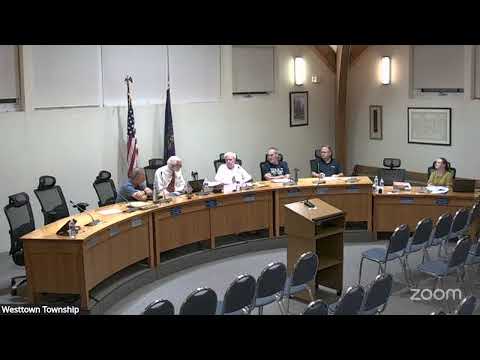
Chair opened the Planning Commission meeting on July 8, 2026, and introduced a review of residential parking requirements after recent complaints prompted a township newsletter and a request from the board of supervisors.
Mila Carter, township planning staff, summarized the relevant zoning provisions and how they are applied: single-family dwellings must provide at least three parking spaces (the count may include garages), the half of the front-yard area nearest the street (50% of the front setback) is a prohibited parking zone, and "parking on grass" is not permitted because the code treats any parking area as impervious for stormwater calculations. Carter told the commission the township generally enforces parking restrictions when driveway- or parking-area expansions are proposed, and that historical nonconforming conditions make routine enforcement difficult.
Several commissioners pressed Carter on enforcement and intent. One commissioner asked how the 50% prohibition is measured; Carter said it's calculated from the street/right-of-way line and is intended to preserve neighborhood aesthetics and the building facade. Commissioners noted the rule can be hard to enforce where older subdivisions have short driveways and recommended the commission evaluate whether the provision remains practical.
During public comment, residents described real-world difficulties they say the ordinance creates. Ted Arnold said the combination of the front-yard prohibition and a 2 a.m. to 8 a.m. restriction on street parking can make it impossible for visiting family or overnight contractors to legally park: "I can't put my son's car anywhere — he can't spend the night," Arnold said. John McGorry and John Regory (both speaking from Fielding Drive) and Lisonbee Glaser described households with multiple working adults and contractors who commonly need early start times, arguing the rules reflect an earlier era of smaller households. Ed Scribe and other residents urged the commission to gather more data before recommending changes.
Carter said residential parking last was revised in 2003 and reported roughly "a dozen or so" parking-related complaints in the last year, and that many driveway-expansion permits have raised the issue. She explained that any new paved parking that increases impervious surface typically triggers engineered stormwater plans that can be costly.
Commissioners discussed next steps and agreed on a pragmatic path: staff will compile complaint counts, past enforcement letters and permit history and compare Westtown's rules with neighboring municipalities and Chester County guidance. Chair suggested staff seek consultant input and recommended the commission ask the board of supervisors to authorize limited funds for analysis if needed. No changes to the ordinance were adopted at the meeting; the commission framed this as an information-gathering review to inform any future recommendation to the board of supervisors.
The public-comment period and staff exchanges made clear the debate centers on competing values — safety, aesthetics and property-use flexibility — and enforcement capacity. The commission indicated it would post follow-up materials and the schedule for further discussion on the planning-commission web page and expected the topic to reappear on a future agenda after staff compiles data and consultant feedback.