Get Full Government Meeting Transcripts, Videos, & Alerts Forever!
Get email alerts on the Public Transit topic
No spam. Unsubscribe anytime.
Medford riders urge MBTA to preserve single-seat rides and accessibility in Better Bus proposals
Summary
At a Medford-focused MBTA Better Bus session, residents pressed planners to avoid cuts that would remove single-seat access to the Red and Green lines, keep key routes (94, 350) and improve frequency on Boston Avenue; MBTA staff said some high-frequency service (the 96) would remain at 15-minute headways.
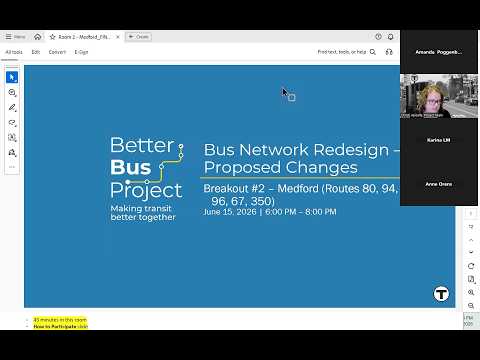
MBTA planners laid out three overlapping packages of proposed route changes for Medford on a virtual focus-group session, and residents raised repeated concerns that the Better Bus options could eliminate important single-seat rides and worsen access for seniors and people with disabilities.
Kristi Apicella, a member of the consultant team supporting the Massachusetts Bay Transportation Authority’s bus transformation office, opened the meeting and invited public feedback. Melissa DeLay, the MBTA’s senior director of service planning, described three decision points: whether to retain existing route structures (including the 350 and the 67), whether to restore route 94 or instead boost frequency on the 80, and how the 96 should be routed through Boston Avenue, High Street, George Street and Winthrop Circle.
“By separating the 80 from the 350, it allows us to dial up the frequency on the 80 independently,” DeLay said, explaining the trade-offs; she added that under one scenario the 80 could run roughly every 20–30 minutes and that the 96 is proposed to remain a high-frequency route. “It would be every 15 minutes or better, 7 days per week,” DeLay said.
Several speakers argued those trade-offs would harm certain neighborhoods. Dan Nowitz said higher frequency on Boston Avenue would “greatly appreciate” Medford’s housing goals. Karina warned that eliminating route 94 could “sever Medford Square” and cut parts of West Medford off from Red- and Green-Line access as new housing comes online. Chase Lehi said West Medford riders would lose direct commuter-rail and subway access without the 94.
Residents also emphasized accessibility and seniors’ needs. Christine Bennett said she is older and that moving buses onto Boston Avenue would create an uphill, difficult walk in winter, calling the change “a serious problem for me.” Stephen Goodrow and David (Gilman Square) said the 80 supplements, rather than duplicates, the Green Line because of steep hills and limited ADA access; David noted Gilman Square station is not ADA accessible and asked MBTA planners to account for growth and housing planned in that area.
Some attendees proposed operational fixes rather than outright deletions. Stefano Lazara suggested scheduling the 80 and 95 to meet so riders could transfer with minimal wait; Eileen Lerner recommended moving a stop from Marshalls to Kohl’s to shorten walks for seniors and families near Mystic Valley Parkway. Anita, who said she had spoken with many Medford residents, recommended option B as the best compromise and argued that keeping 94 service would preserve access to Medford Square and reduce overflow at the rotary.
MBTA staff clarified specific elements: the plan would propose making route 95 run every 20 minutes, seven days a week; the 96 would remain high-frequency and extended to Malden on one end and to Union/East Somerville on the other; and one package would propose terminating the 80 at Davis Square rather than paralleling the Green Line further south.
The session ended without a vote. Planners encouraged written comments and directed attendees to the Better Bus survey and the meeting chat for additional input; the MBTA said chat and transcription would be saved.
What happens next: MBTA planners said the packages are not strictly exclusive and can be mixed; public feedback will be used to refine routing and frequency trade-offs before final recommendations are posted and implemented.