Get Full Government Meeting Transcripts, Videos, & Alerts Forever!
Get email alerts on the Wildlife Shorebirds topic
No spam. Unsubscribe anytime.
Kiawah Island stewards say shorebird numbers have plunged; island a major spring stopover for red knots
Summary
At a public Kiawah Island presentation, stewards cited multi-decade declines in shorebirds and emphasized local protections after saying about 17,000 red knots stage on the island each spring — roughly 41% of the eastern population — making the island locally critical for migration.
At a public presentation on Kiawah Island, stewards described steep, long-term declines among shorebirds and highlighted the island’s outsized role as a spring staging area for red knots.
“Since 1970, 2,900,000,000 birds have disappeared,” said Erin, the presentation’s primary speaker, summarizing a 2019 State of the Birds report and later research showing declines across many shorebird species. Erin cited species-level declines including an about-80% drop in ruddy turnstones since the 1970s and 70–80% declines in red knots in some periods since the 1980s.
Erin said red knots are of particular local concern because Kiawah is a major staging site. “A recent study … shows that about 17,000 red knots pass through Kiawah Island here in the spring,” Erin said, adding that number represents roughly 41% of the eastern (rufa) red knot population.
Why it matters: red knots are federally threatened and rely on high‑calorie food sources at staging sites to fuel their long migrations to Arctic breeding grounds. Erin told the audience that local threats include habitat loss from shoreline change and development, disturbance by people and dogs, predation by gulls and crows, and reduced food from horseshoe crab harvesting along migratory routes.
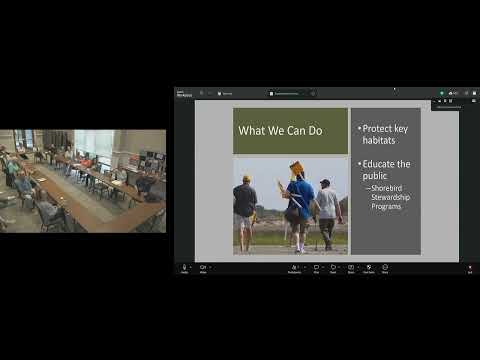
Locally, the stewardship group has tightened protections and signage. Erin described two island areas designated as critical habitat under a local ordinance and aligned with U.S. Fish and Wildlife Service mapping; dogs are banned year‑round in those zones. On the West End, stewards tried stringing thousands of feet of rope between posted signs to block pedestrian traffic and reported fewer footprints in the roped areas, though flooding from storms knocked out nesting attempts last season.
Erin emphasized that some species respond to local beach protections while others — especially Arctic‑nesting species — face threats beyond local control. “Species that nest in the Arctic…there’s not much that we can do to protect breeding habitat on those species because there’s really no people up there anyway,” Erin said, noting that protection efforts are most effective on wintering and staging grounds where people and programmatic measures can reduce disturbance and protect food resources.
Numbers reported from monitoring: Erin said Kiawah historically hosted large least tern colonies (more than 150 pairs in 2020–21), reported about 23 Wilson’s plover pairs in 2024 (falling to an estimated 12–15 pairs the following year), an estimated 6–8 American oystercatcher nests last year (success unknown), and that Dunlin roosts on the East End can exceed 10,000 birds in fall and winter.
Audience exchanges included a technical discussion about horseshoe crab use in biomedical assays; a participant who identified as a retired pathologist said pharmaceutical firms have developed synthetic alternatives to natural horseshoe crab lysate that regulators have deemed equivalent.
The presentation closed with a reminder that local stewardship actions — roped enclosures, signage, seasonal dog rules and volunteer stewards — are intended to reduce disturbance and help migratory and nesting shorebirds complete critical life stages. Cindy McKinley, the new coordinator of the Kiawah Island Shorebird Stewardship Program, followed the presentation with an invitation for residents to join the program and help protect the island’s birds.