Get Full Government Meeting Transcripts, Videos, & Alerts Forever!
Get email alerts on the IReady Diagnostic topic
No spam. Unsubscribe anytime.
Long Hill Township School District leaders explain i-Ready diagnostic and how parents can support students
Summary
District Superintendent George Alexis and Dr. Laurie Jones walked parents through the i-Ready diagnostic and MyPath instructional features, explained reporting and recommended weekly practice (40 minutes per subject for grades 2–8; 40 minutes total for K–1), and answered technical-access questions.
Long Hill Township School District officials outlined how the i-Ready diagnostic will be used to screen students and personalize instruction during a virtual parent information session. Superintendent George Alexis introduced the program and turned the presentation over to Dr. Laurie Jones, who described how diagnostics, MyPath lessons and teacher reports work.
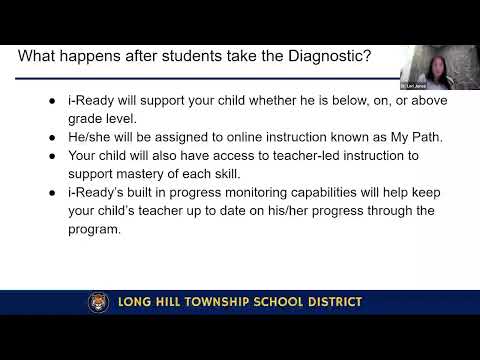
Jones said the i-Ready diagnostic is an adaptive screener intended to identify students’ strengths and weaknesses by domain — phonological awareness, phonics, vocabulary and comprehension for reading, and numbers/operations, measurement and geometry for math — and to generate a personalized MyPath of instructional lessons. "The test is really designed to find exactly the level in which your child is performing," Jones said, adding that MyPath is distinct from teacher-assigned work and updates as students complete lessons.
The district will administer three diagnostics per year. Jones described typical timing and duration: grades 1–8 are tested in the first two weeks of school, kindergarten in the first four to six weeks, and diagnostic sessions usually take about 50 minutes for K–1 and about 90 minutes for grades 2–8. Jones said i-Ready recommends splitting diagnostics into sections, which the district has implemented.
District expectations for at-home practice were front‑and‑center: Jones said the district requires grades 2–8 to complete 40 minutes of reading and 40 minutes of math per week in i-Ready; kindergarten and first grade should complete 40 minutes total (20 reading, 20 math) until the first trimester ends. "We recommend one reading lesson and one math lesson per night," Jones told parents. She also noted that i-Ready considers a lesson passed at a score of 67% or higher.
Officials emphasized that i-Ready supplements classroom instruction rather than replacing it. "We don't want to replace in-person instruction," Superintendent Alexis said, calling i-Ready "a really good aid in personalizing instruction" and tying the rollout to a district goal on improving small-group teaching.
On data use, Jones said teachers receive weekly reports showing growth trends, skill mastery and suggested next steps. She urged parents to review reports with children, celebrate progress and set consistent study routines. "It doesn't mean they're not going to do well overall," Jones said when advising parents whose children struggle on an initial diagnostic.
Parents raised practical questions in chat about accessing reports and technology. Jones said diagnostic results would be posted in the parent portal under the Documents tab and that the district would resend instructions to families who cannot locate scores. When a parent asked whether parental-control settings must be disabled to use i-Ready, Mr. Hartnett, identified in the session as the district’s director of technology, explained that some parental-control filters can block the specific URLs i-Ready uses; he recommended adjusting settings rather than turning protections off entirely.
Jones also listed other district assessments used to inform instruction — DIBELS (K–3), Fountas & Pinnell (K–6), Heggerty phonics (K–1), district writing prompts and Big Ideas chapter benchmarks for math — and said i-Ready is one component in a broader assessment strategy.
The session closed with officials offering follow-up help: Jones invited parents to email or schedule a Google Meet walkthrough to review individual reports. "If anybody has any questions about their child's scores, you can definitely reach out to me," she said. The session ended after a brief Q&A and expressions of thanks.