Get Full Government Meeting Transcripts, Videos, & Alerts Forever!
Get email alerts on the Housing Development topic
No spam. Unsubscribe anytime.
Santa Rosa neighbors press for fire, evacuation and infrastructure analysis after 42-home Meadow at Rincon Valley proposal
Summary
At a City of Santa Rosa neighborhood meeting on the Meadow at Rincon Valley proposal, residents raised sustained concerns about wildfire risk, evacuation capacity, traffic, stormwater and who will pay for infrastructure; city staff said the application is under initial review, no decisions were made and required technical reports will be examined.
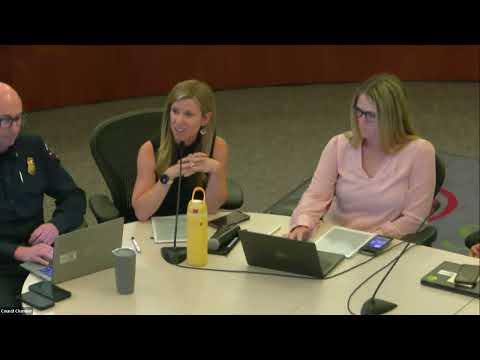
City of Santa Rosa planning staff and the applicant presented details of the Meadow at Rincon Valley proposal at a neighborhood meeting where dozens of residents urged the city to require more analysis on wildfire safety, evacuation routes, traffic and infrastructure funding before permitting moves forward. The applicant described a revised submittal of 42 detached homes on lots averaging about 4,500 square feet; staff said the proposal is still in initial completeness review and that no decisions would be made at the meeting.
Residents said the area has a repeated wildfire history and limited egress during past evacuations and asked the city for a more conservative, evidence-based approach. “The 3rd time is a trend,” said Diane Estance, recalling fires that approached the neighborhood in recent years and urging the developer and city to reduce the proposed density. Other speakers described being evacuated multiple times, losing insurance coverage and fearing that added units and years of construction traffic would strain local streets and lower property values.
Why it matters: Neighbors and several speakers asked for three principal assurances before approval: a transparent fiscal-impact analysis that compares long-term service costs with one-time developer fees, realistic wildfire and evacuation modeling under peak conditions, and demonstrated road, water and storm drainage capacity. Jamie Thompson told staff, “I am asking for a transparent fiscal impact analysis,” and multiple commenters requested that any road-widening or emergency-access improvements be funded and scheduled before heavy grading and construction begin.
What the developer said: The applicant said the earlier concept (45 units) was reduced to a 42-unit submittal with only detached housing and a mix of single- and two-story plans; he estimated a best-case start of site work in 2029–2030 and acknowledged construction could take multiple years. The applicant told residents that Zimmerman Lane is unlikely to be used for general construction access and that trucks would likely use paved roads such as Bridgewood.
Staff responses and technical obligations: City planners and engineering staff repeatedly told residents that technical reports are required as part of the entitlement package. City engineering staff said the development must demonstrate capture and treatment of all stormwater runoff, submit drainage and low-impact development reports, and prove no net worsening of downstream flows. On the question of annexation and utilities, staff said whether properties on private lanes like Zimmerman must connect to city water or sewer depends on recorded easements and LAFCO decisions; the city will not place public utilities in a private roadway without legal easements.
Fire and evacuation: The Santa Rosa fire division chief acknowledged past evacuation problems and described how the city has changed procedures since 2017. The fire marshal and transportation and public-works staff said the project as designed provides the city’s required points of access without relying on Zimmerman, and they described a coordinated evacuation 'flush plan' the city uses with police, fire and transportation to manage large-scale evacuations. Staff said some neighborhood residents may still opt to pursue an emergency-vehicle-access upgrade on private lanes, but that would require bringing those lanes into compliance with city standards and any required Knox/Opticom controls.
Remaining community concerns: Neighbors pressed that the project's transportation impact study needs broader sampling (multiple intersections and school-term conditions rather than short-duration counts), questioned the stormwater assumptions given local unmaintained creeks, and pressed who will repair and finance local roads after years of heavy construction traffic. Traffic staff said developers are responsible for repairing construction damage and noted the city has separate road-maintenance programs for larger resurfacing work.
Next steps: Staff reiterated that the application remains under completeness review, that required drainage, transportation and other technical studies will be examined during the entitlement process, and that project materials are available on the project webpage. No vote or formal action occurred at the meeting; staff said they will remain after the session to take follow-up questions and that the recorded meeting will be posted online.
The meeting closed with staff offering to continue one-on-one discussions and to provide the technical materials already posted on the project page.