Get Full Government Meeting Transcripts, Videos, & Alerts Forever!
Get email alerts on the Environment topic
No spam. Unsubscribe anytime.
Select board authorizes ProcellaCore treatment in two milfoil hotspots after DES review
Summary
Following staff and DES briefings and extensive public discussion, the board approved use of ProcellaCore at two high‑density milfoil sites (Back Bay and Devil's Cove area of Crescent Lake), with DES oversight; one board member opposed the authorization.
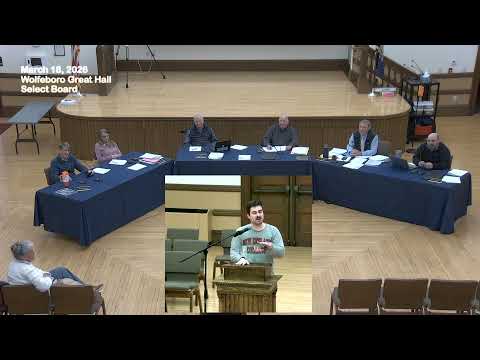
The Wolfeboro Select Board voted March 18 to authorize chemical treatment using ProcellaCore in two targeted milfoil areas identified by the town’s milfoil committee and Department of Environmental Services (DES). The vote follows years of hand‑pulling, diver work and DEP assessments; staff and the committee said hand removal alone did not sufficiently control the invasive Eurasian watermilfoil in the two locations.
The committee’s representative explained the proposed areas: parts of Back Bay that are difficult for volunteers and a choked cove at Crescent Lake. A DES contact told the board the product has been approved for aquatic invasive control and that modern formulations degrade quickly; the committee said there are no drinking‑water or fishing restrictions under current application protocols. "We don't go out of our way to treat," a committee representative said; "we only do a chemical treatment when there's no other alternative."
Board members debated tradeoffs. Some raised ecological concerns about removing dense aquatic vegetation that provides habitat and about long‑term unknowns for newer products; others said uncontrolled milfoil has repeatedly returned despite hand removal and presents safety and navigation problems for small craft. After discussion, a majority approved the limited treatment plan carried out under DES permitting and contractor oversight; one selectman stated publicly that he could not support the authorization.
Staff said the town will follow DES protocols, retain documentation of chemical use, and monitor treated areas for recovery and any unintended effects. The milfoil committee will publish survey and monitoring results and coordinate volunteer follow‑up where appropriate.