Get Full Government Meeting Transcripts, Videos, & Alerts Forever!
Get email alerts on the Omb Rule topic
No spam. Unsubscribe anytime.
OMB proposal would centralize grant decisions and curb international collaboration, speakers say
Summary
Speakers at a May 29 meeting criticized a newly released Office of Management and Budget rule proposal, saying it would bar international collaboration by federal grant recipients, restrict communications with the press and give administration officials broad authority to halt funding.
On May 29, presenters at a public discussion raised alarms about a new rule proposal released by the Office of Management and Budget. Presenter (S1) said the proposal would bar federal grant recipients from international collaboration, limit what recipients may say to the press and give administration officials the authority to stop grants at any time.
"We're viewing this as a direct assault on democracy, on Congress's power of the purse, but also on science," Presenter (S1) said, summarizing the proposal's potential effects on research and congressional oversight.
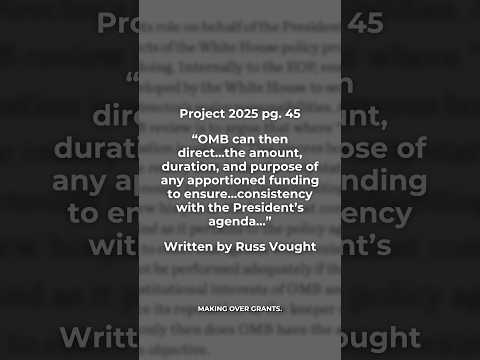
A second presenter (S2) placed the proposal in the context of Project 2025, saying Russell Vought was a chief architect of that road map and that the plan called for centralizing decision-making over grants. "He uses the term 'unitary executive,'" Presenter (S2) said, adding that the approach would vest control of program choices with the presidency rather than with Congress.
Presenters described the proposal as extending beyond scientific programs to a broad range of federal grants and as altering who decides which grants are funded. The transcript records repeated concerns that the rule would allow administration officials to halt funding and to require alignment of grant activity with administration priorities.
The transcript does not record a formal response from Office of Management and Budget officials or any vote or formal decision; the document captures speakers’ statements and contextual remarks.
Next steps for the proposal are not recorded in the transcript provided.