Get Full Government Meeting Transcripts, Videos, & Alerts Forever!
Get email alerts on the Pier Lease topic
No spam. Unsubscribe anytime.
Colonial Beach council narrows proposed pier-lease rules, offers rent incentive for shoreline work
Summary
After extensive public comment and council debate, Colonial Beach council directed staff to revert to previous inspection language for pier leases, agreed to draft lease-transfer protections for buyers, and endorsed an incentive (a full rent reduction for the five-year lease term) if homeowners submit and implement a professional shoreline-management plan (Exhibit B).
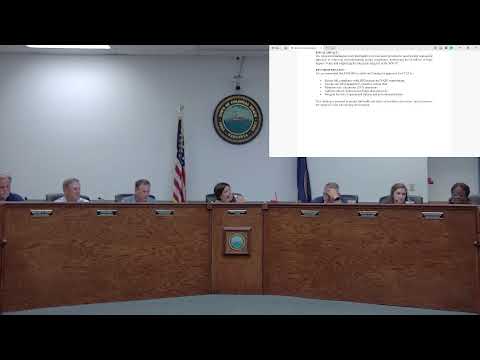
Councilors debated revisions to the town's standard pier-lease form for roughly two hours on June 18, ultimately directing the town attorney to prepare a clean draft that pares back new inspection language, clarifies transfer rules for home sales, and offers an incentive for voluntary shoreline protection work.
The issue began when Town Attorney Duggan reviewed a redline of the draft lease and described three options for shoreline maintenance: require a plan and implementation if the town manager or designee finds a material erosion risk; make a plan optional; or allow voluntary plans with a rent reduction. Duggan said the shorter, five-year lease terms were intentional to avoid indefinite contractual commitments and to bring leases back in line with prior practice.
Several council members and residents warned the newly proposed inspection-trigger language could impose unreasonable administrative and technical burdens. "I would propose to strike that entire sentence," the mayor said of the new phrase that would have empowered the town manager's designee to determine whether construction or an existing dock "is likely to cause material erosion." Councilor Allison and others argued that construction permits and county inspections already address much of the technical review for new piers.
After extended discussion about who would pay for professional engineering reviews and how to manage borrower/buyer expectations when a home with a pier is sold, the council agreed on several directives to be reflected in a revised lease: return to the prior, less prescriptive inspection language that allows the town to require shoreline maintenance when appropriate; require a transfer-assignment document so a buyer must agree to the lease terms; and keep the leased area defined as an extension of the parcel boundary via a recorded plat or survey.
Councilors also debated rent and an incentive structure for homeowners who proactively plan and carry out shoreline protection. The draft discussion proposed a percentage reduction; council settled on the principle of a substantial rent incentive to encourage implementation. "If someone says, —I want to put riprap; can I have a break on the lease?' Why wouldn't we do that?" Councilor Larson asked, and the body directed staff to include an incentive (the council discussed a 100% reduction on the modest multi-year lease fee as the operational incentive for a certified Exhibit B and implemented plan).
Duggan told council he would incorporate the changes and produce a clean copy for the July meeting or sooner if authorized. The council did not adopt the lease language formally that night; it gave staff direction and requested the updated document for final action.
What happens next: the town attorney will prepare a new, consolidated lease draft reflecting the council's direction on inspections, transfers, exhibit B incentives and an updated rent schedule; staff will return the clean copy to council at the next regular meeting for formal adoption.