Get Full Government Meeting Transcripts, Videos, & Alerts Forever!
Get email alerts on the Pedestrian Bridge topic
No spam. Unsubscribe anytime.
Consultant recommends arch-capstone pedestrian bridge over Naugatuck River
Summary
A consultant recommended an arch (capstone) pedestrian and bicycle bridge aligned with Rubber Avenue, coupled with a box-culvert under the railroad; the project is at ~30% design, funded by a Reconnected Communities grant, with NEPA work and a public meeting planned before final design in late 2026.
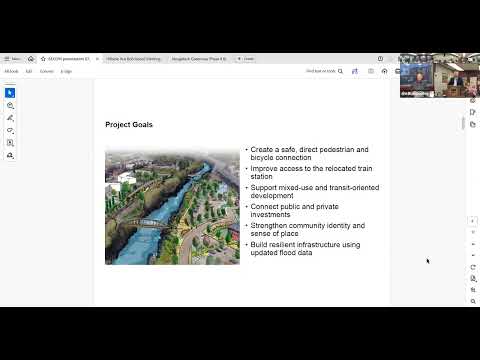
A consultant working with the borough recommended an arch-style, capstone bridge to connect the west and east sides of town across the Naugatuck River and a box-culvert "tunnel" under the railroad, presenting the design as the "preferred alternative." The recommendation was described at the board meeting as the most cost-effective and aesthetically pleasing option to link the relocated train station, the transit-oriented development and neighborhoods on the east side of the river.
The consultant told the board the current phase has reached roughly 30% preliminary design and includes preparing National Environmental Policy Act (NEPA) documentation required to allow federal transportation funds. "This is our proposal for a new pedestrian bridge...and a box culvert underneath the railroad," the Consultant said, adding the work will support future grant applications by quantifying benefits such as mode shift and air-quality improvements.
Design trade-offs discussed included structural type and hydraulic clearance. The consultant said the selected capstone arch provides better aesthetics while still allowing about 9 feet of headroom through the railroad culvert — short of an ideal 10 feet but preferable to the more costly rectangular gateway truss. The firm noted the bridge must sit above the 100-year flood elevation and that the design balances flood-clearance, user comfort and cost.
Board members asked about decking, lighting, winter maintenance and emergency access. The Consultant said decking options under consideration include timber decking (longer life, popular on multiuse trails) or asphalt; lighting design will be developed in the final design phase and the structure will be ADA-accessible and wide enough for small maintenance or emergency vehicles if the borough chooses to plow.
The project is funded in this phase by a Reconnected Communities grant. The consultant said a draft NEPA package will be submitted to federal agencies at the end of October to allow roughly 60 days for review and to aim for project-phase completion by December 2026, with an additional public meeting planned in the fall to show refined designs and visuals.
Next steps: the board gave direction to proceed with the recommended capstone arch alignment and move into the next level of preliminary design and NEPA work.