Get Full Government Meeting Transcripts, Videos, & Alerts Forever!
Get email alerts on the City Hall Public Access topic
No spam. Unsubscribe anytime.
Carmel committee hears public pleas to keep City Hall restrooms available as draft ordinance draws legal concerns
Summary
Public commenters and concert organizers urged the Carmel Land Use Committee to preserve indoor restroom access and avoid forcing rentals after City Hall bathrooms were closed; city legal counsel warned the draft ordinance could be too broad and asked staff for a narrower framework and cost data.
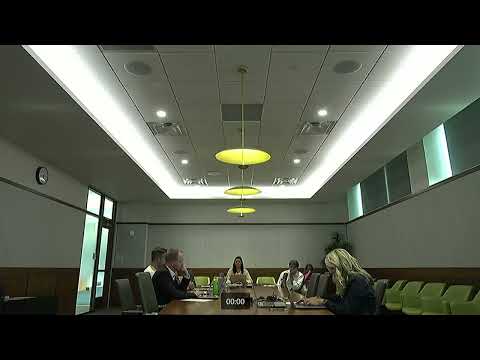
Anita Joshi, chair of the Carmel Land Use Committee, opened a July 8 meeting to discuss ordinance D‑2795‑25, a draft measure described as establishing "public areas of City Hall," and invited public comment.
John Eaton of the Gazebo Concert Series committee told the panel the closure of the fountain‑level bathrooms has forced organizers to rent two trailer‑style porta‑potties and a stand‑alone ADA unit for concerts. Eaton said the rentals cost "somewhere in the neighborhood of $1,000 to $1,200 each week," and noted the series runs 16 concerts, a recurring expense he estimated at about $16,000 a season. "We need more restrooms," Eaton said, adding that long lines — sometimes 30 minutes — make attendance difficult for elderly patrons and parents with small children.
The committee also read a written comment from long‑time attendee Jack Feldman, who argued that City Hall is a taxpayer‑funded public building and that moving meetings earlier or offsite would reduce access for working residents. "A citizen may attend a meeting to see the results of an important issue facing their neighborhood," the letter said, urging preservation of the building as a place "for and of the people."
City legal counsel Sergei Gutricken told the committee the draft ordinance, as written, risks creating a traditional public forum in parts of City Hall, which would sharply limit the city’s ability to regulate speech there. "This ordinance, as it is written right now, it's very close to creating a traditional public forum in some areas of City Hall, which is very problematic," Gutricken said, noting that different forum classifications (traditional, designated, limited) carry different constitutional standards and enforcement implications.
Gutricken and other staff also said the fountain‑level restrooms have been closed in part because of vandalism, theft and drug paraphernalia routinely found in the space, and because the facilities need restoration. Staff cautioned that reopening the interior bathrooms would require repairs and staffing; they pointed to existing processes for facility‑use requests handled by the Board of Public Works and asked the committee what scope the ordinance should have.
Committee members asked staff to provide detailed cost comparisons — for example, how much the city spends on porta‑potty rentals versus staffing City Hall for events (staff cited prior figures of about $50 per hour for on‑site staff and mentioned an earlier, approximate $125 payment in a different context). Councilor Ryan Lye asked whether the ordinance language belongs in city code and requested memos with historical and fiscal information.
The committee did not vote on the ordinance. Chair Joshi said the measure could proceed procedurally in its present form but asked staff and legal counsel to return with a narrowed framework that addresses safety, accessibility and fiscal impacts before the council takes further action.
The Land Use Committee scheduled no final action at the meeting and directed staff to provide additional information to refine the draft ordinance.