Get Full Government Meeting Transcripts, Videos, & Alerts Forever!
Get email alerts on the Anti Blight Ordinance topic
No spam. Unsubscribe anytime.
Cochise County staff propose consolidated anti‑blight ordinance; public hearing set for July 28
Summary
County code compliance staff told the Board of Supervisors they plan to consolidate multiple nuisance ordinances into a single Anti‑Blight Nuisance Abatement Ordinance to streamline enforcement, improve cost recovery and preserve due process; a public hearing is scheduled for July 28.
Cochise County code compliance staff presented a proposed Anti‑Blight Public Administration Abatement Ordinance at a July 7 work session, saying the consolidated code would modernize a patchwork of older nuisance provisions and make enforcement more efficient while preserving property‑owner due process. McLaughlin, a county code compliance staff member, told the Board of Supervisors the measure would not expand county authority but would bring existing procedures together under state law.
"The purpose of this ordinance is to modernize the county's code compliance program by creating one clear, consistent process for nuisance enforcement," McLaughlin said, adding that the proposal relies on existing Arizona law and recent state changes. She told supervisors the ordinance would preserve written notice, appeal rights, the option for hearing‑officer review when requested, board appeal rights and judicial review.
McLaughlin said the county’s code compliance operation must account for rural realities: Cochise County covers more than 6,200 square miles and currently has two full‑time code compliance staff. The ordinance would emphasize voluntary compliance where possible, clarify who is legally responsible for correcting a nuisance when ownership is unclear (for example in probate or when tenants occupy property), and provide clearer tools for abating hazardous conditions such as illegal dumping, unsafe structures and emergency threats to public health.
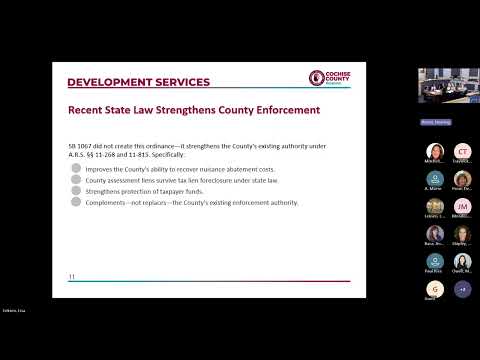
A central fiscal change in the proposal would strengthen cost recovery. McLaughlin described the county’s abatement fund, which pays for cleanups when owners fail to act, and said recent state legislation—identified in the presentation as Senate Bill 1067—preserves nuisance‑assessment liens through tax‑lien foreclosure. That lien protection, she said, should improve the county’s ability to recover cleanup costs from responsible parties; McLaughlin said the change takes effect Sept. 12 and is scheduled to sunset in 2028 unless extended.
Board members pressed staff about enforcement limits in specific cases. Supervisors raised a longstanding junkyard example and asked whether the ordinance would allow the county to prevent expansion of nonconforming uses; McLaughlin said zoning and 'grandfathering' remain separate issues and that any zoning changes would be considered separately, while the ordinance would give code compliance more tools to address violations and limit expansion.
Supervisors also asked about practical challenges: locating absentee owners, dealing with squatters on vacant lots, and safe service of notices. McLaughlin said staff spends significant time tracing responsible parties—including heirs in probate cases—and recommended additional measures such as posting, cameras and prompt cleanup to discourage repeated dumping. The board discussed using paid constables or sheriff deputies to serve notices; McLaughlin noted the county budget includes $20,000 for the Benson constable and said constables can serve notices within their districts, though service can sometimes be dangerous.
On procedure, McLaughlin said a notable efficiency would be removing the automatic requirement for a hearing‑officer proceeding in every case: responsible parties would retain the right to request a hearing, but absent a request the county could move cases along the administrative path to resolution. That change, she said, reduces unnecessary administrative hearings while preserving appeal rights.
McLaughlin concluded by asking for board direction and said staff could place the ordinance on the agenda for a public hearing on July 28 during a regular board meeting, where members of the public would have the opportunity to comment before the board considers adoption. If adopted, she said, the county would update internal procedures, forms and public information to implement the ordinance.
The board did not take a formal vote at the work session; the next step is the scheduled public hearing.