Get Full Government Meeting Transcripts, Videos, & Alerts Forever!
Get email alerts on the Pollinator Conservation topic
No spam. Unsubscribe anytime.
Judy Cardine of Wisconsin DNR urges homeowners to plant natives, leave stems and avoid pesticides to help struggling bumblebees
Summary
In an online webinar hosted by Friends of Northpointe, Wisconsin DNR educator Judy Cardine said residents can help native bees by planting diverse native flowers, leaving stems and leaf litter for nests and avoiding pesticides; she cautioned against starting backyard honeybee hives as a conservation tactic.
An online webinar sponsored by Friends of Northpointe and the Lakeshore Natural Resource Partnership on (date not specified) offered practical steps homeowners can take to support Wisconsin’s native bees, including the endangered rusty‑patched bumblebee.
Judy Cardine, a bumblebee educator affiliated with the Wisconsin Department of Natural Resources’ community science program, told attendees the state is home to roughly 500 bee species and that most — about 85% — are solitary. “Don’t start a honey bee hive in your backyard,” Cardine said, explaining that honeybees are agricultural livestock, can outcompete native bees for resources and may spread diseases to native populations.
Cardine said habitat loss, pesticide use, disease and climate change are the main drivers of declines. She noted that several bumblebee species have seen dramatic reductions in range and numbers and that the rusty‑patched bumblebee’s range has contracted sharply; it was declared federally endangered in 2017. “We bear a special responsibility in Wisconsin to try to support the rusty‑patched bumblebee,” she said.
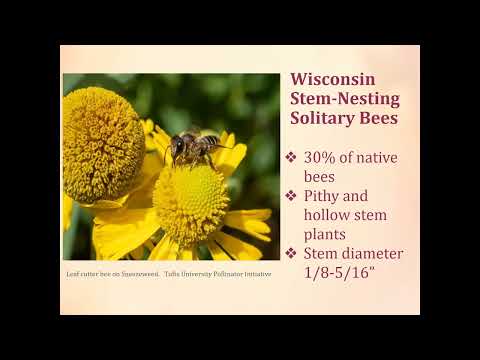
Her recommendations for residents focused on yard‑level actions: replace turf with native plantings that provide blooms from April through October; create a mosaic of bare ground, leafy areas and varied soil for ground‑nesting bees; preserve hollow stems and standing vegetation for stem‑nesting species; stop routine spring cleanup that removes nests; and eliminate pesticides, including systemic insecticides sold as ‘neonics.’
Cardine offered specific, practical guidance: leave stems standing through multiple seasons, cut stems to varying lengths (8–24 inches) when necessary, and provide late‑blooming flowers such as showy goldenrod and New England aster to help new queens fatten for hibernation. She also described typical nest sites — abandoned rodent burrows, birdhouses with nesting material, and surface nests under vegetation — and how to recognize small hibernation holes in a lawn.
The webinar included a question‑and‑answer period in which Cardine cited several studies showing disease transmission from managed honeybees to native bees and discussed the limits and maintenance needs of commercially sold “bee hotels.” She recommended participating in the Wisconsin Bumblebee Brigade, the DNR’s community science photo‑submission program, to help the agency track populations.
Hosts said they will share the presentation slides, the recording and Cardine’s resource links after the event; attendees were also directed to the Wisconsin/Midwest Bumblebee Observers Facebook page for additional guidance.
The webinar emphasized practical, nonregulatory measures that residents can adopt immediately to improve pollinator habitat while noting that broader landscape and agricultural changes are also needed to reverse long‑term declines.