Get Full Government Meeting Transcripts, Videos, & Alerts Forever!
Get email alerts on the Junior High Wrestling Coop topic
No spam. Unsubscribe anytime.
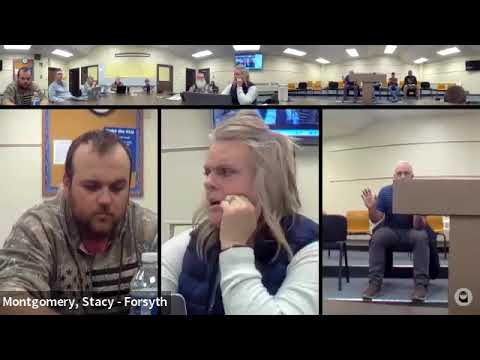
Forsyth board approves interlocal agreement to let Haisham junior-high students join wrestling; travel, prorated fees required
Summary
Forsyth——s board voted 5-0 to approve an interlocal agreement allowing Haisham junior-high students to participate in Forsyth——s wrestling for the remainder of the season, with Haisham responsible for transportation and a prorated, per-student share of program costs; board members stressed caution about setting a broader precedent.
Forsyth School Board members voted unanimously to approve an interlocal agreement enabling one or more Haisham junior-high students to join Forsyth——s junior-high wrestling program for the current abbreviated season, with travel and liability assigned to Haisham and costs split on a prorated, per-student basis.
Board member and meeting chair Kate (S1) called for a motion after board members negotiated language on transportation, liability and how to prorate fees for a late-season entry. "All in favor, same 5 aye," Kate declared after the motion passed.
The district staff member who drafted the proposed agreement (S2) told the board she had consolidated information from the schools into a formal draft and that insurers and legal counsel had been consulted. She said the draft includes a clause making clear that if Haisham chooses not to provide transportation, Haisham—not Forsyth—would retain responsibility for any incidents that occur en route.
Forsyth——s staff (S3) provided cost estimates used in the discussion: coach and assistant pay and prior fuel and bus-driver costs. Board members said the previously proposed flat 50/50 split was not appropriate given the likely imbalance in participant numbers, and they agreed to a per-student percentage formula, prorated for the shortened season so Haisham pays only its share for remaining events.
Several board members voiced concern that allowing out-of-district athletes could create a precedent with budgetary consequences. One board member (S4) warned the district must consider long-term implications for A/B funding and local enrollment, saying the board needed to "do what is best by our school district, our students, our taxpayers." Other members countered that a small, narrowly defined pilot for junior-high wrestling could improve the competitiveness and experience of Forsyth athletes without materially raising costs.
The board discussed policy constraints flagged by counsel and by district insurance counsel. S2 noted Montana High School Association (MHSA) guidance and equity considerations: "You can't ask a parent to transport the kids because you get into an equity thing," she said, explaining why the agreement should make transport responsibility explicit.
Board members settled on language that (1) specifies Haisham is responsible for transporting its students to Forsyth practices and events unless the agreement states otherwise; (2) requires participating students to meet Forsyth eligibility conditions (impact/concussion testing, a physical); and (3) calculates Haisham——s share as a prorated per-student percentage for the abbreviated season, with a standing annual review to reassess costs and participation.
The motion to approve the interlocal-agency agreement with the fee-language changes discussed was moved and seconded in open session and carried by voice vote ("same 5 aye"). The board scheduled a special meeting Friday for signatures and asked Haisham to provide the student——s completed eligibility paperwork (impact test, physical) before participation.
The vote ends the board——s immediate deliberations on this coop, but members asked staff to return after the season to report on how the arrangement worked and whether any long-term policy changes are needed.